
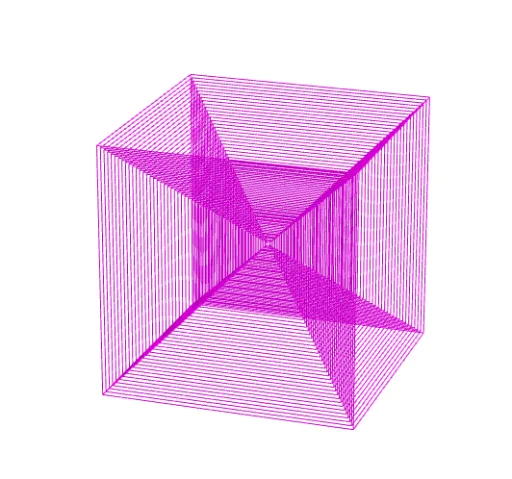
Rotating Cubes on the Diagonal
Loading the math board and drawing, please wait…
This example demonstrates the rotation of cubes along a diagonal in three-dimensional space. It involves core mathematical concepts such as solid geometry, volume calculation, and spatial transformation. The construction utilizes GeoGebra commands and objects like Point, Cube, and Sequence. It is suitable for high school students and above to learn and understand spatial geometry and volume changes, as well as for mathematical demonstrations.
GeoGebra Commands & Parameters
Point(Circle[(0.5, -0.5, -0.5), Distance[(-0.5, -0.5, -0.5), (0.5, -0.5, -0.5)], Segment[(-0.5, -0.5, -0.5), (0.5, -0.5, -0.5)]]) → ACube((-0.5, -0.5, -0.5), (0.5, -0.5, -0.5), A) → a, B, faceABFE, faceCDEF, edge2, edge1, edge4, edgeAB, edge3, edgeBF, edgeCF, edgeCD, C, edge5, edgeDE, edgeAE, edgeEF, D, E, F, face1, face3, face2, face4Sequence(Rotate[Dilate[a, w], (n * w), Line[(0.5, 0.5, 0.5), (-0.5, -0.5, -0.5)]], w, 0.2, 10, 0.2) → L_1