
Rotating Circles Intersection Points
Loading the math board and drawing, please wait…
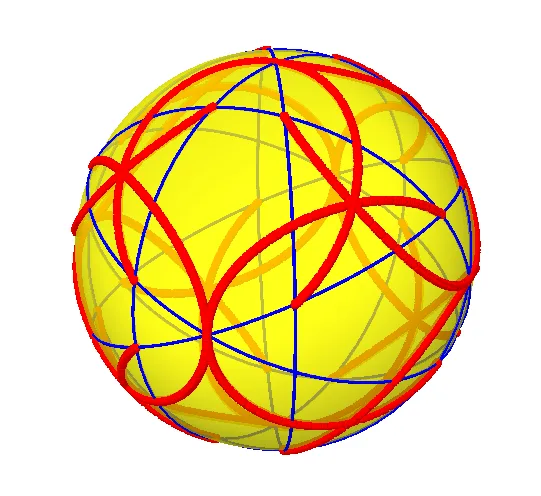
This example demonstrates the dynamic intersection points of two rotating circles, showing how their intersections change as the circles rotate in 3D space. The core mathematical concepts involve circle rotation, intersection of circles with spheres, and locus generation in three dimensions. Construction uses GeoGebra commands such as Intersect to compute intersection points between circles and spheres, and Rotate to rotate the circles. A slider t controls the rotation angle, allowing real-time observation of the moving intersection points. Objects include circles c, d, e and their rotated versions c', d', e', along with multiple labeled intersection points. Suitable for high school or college solid geometry lessons, and for exploring how parameters affect intersection loci, enhancing understanding of geometric interactions in 3D.
GeoGebra Commands & Parameters
Intersect(xAxis, zAxis) → ASphere(A, 1) → aIntersect(zAxis, a) → B, CIntersect(yAxis, a) → D, EIntersect(xAxis, a) → F, GCircle(D, C, E) → cCircle(G, C, F) → dCircle(F, D, G) → eRotate(d, t, xAxis) → d'Rotate(d, (-t), xAxis) → d'_1Rotate(c, t, zAxis) → c'Rotate(c, (-t), zAxis) → c'_1Rotate(e, (-t), yAxis) → e'Rotate(e, t, yAxis) → e'_1Intersect(d', e'_1) → H, I, ,Intersect(d', c') → J, K, ,Intersect(e'_1, c') → L, M, ,Intersect(c', d'_1) → N, O, ,Intersect(d', d'_1) → P, Q, ,Intersect(e', e'_1) → R, S, ,Intersect(e', d') → T, U, ,Intersect(e'_1, d'_1) → V, W, ,Intersect(e', d'_1) → Z, A_1, ,Intersect(c'_1, c') → B_1, C_1, ,Intersect(c'_1, e') → D_1, E_1, ,Intersect(e', c') → F_1, G_1, ,Intersect(c'_1, e'_1) → H_1, I_1, ,Intersect(c'_1, d'_1) → J_1, K_1, ,
AI Drawing Prompt Reference
Draw the intersection points of two rotating circles in 3D space. Start by setting up the coordinate axes and creating a unit sphere centered at the origin, then find the initial positions of the circles by intersecting the sphere with the axes. Next, create three circles c, d, e and rotate them around the x-axis to generate their rotated versions c', d', e'. Use rotation and intersection operations to find the intersection points H, I, J, K, L, M, N, O, P, Q, R, S, T, U, V, W, Z, A_1, B_1, C_1, D_1, E_1, F_1, G_1, H_1, I_1, J_1, K_1 at different rotation angles.
The prompt above was compiled from the original drawing commands and is for reference only.