
Special Confocal Darboux Cyclides from Circle Families
Loading the math board and drawing, please wait…
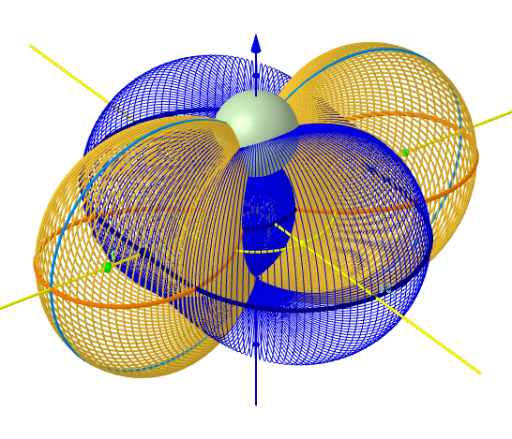
This example demonstrates how to construct a special confocal Darboux cyclide in 3D, highlighting that the surface is formed by a family of circles and exhibits strong symmetry. Key concepts include Darboux cyclides (as circle-generated surfaces), confocal constraints, and the geometric/analytic representation of such surfaces in both implicit and parametric forms. In GeoGebra, the build relies on Point and Intersect to define key points and intersection loci; Circle, Line, and LineBisector to generate circle families and symmetric lines; Mirror, Midpoint, and Rotate to enforce geometric transformations and invariances; ImplicitCurve (and CurveCartesian) to visualize the resulting surface or defining curves; and 3D primitives like Sphere together with lines to organize the spatial configuration. Sequence and Zip are used to generate parameter samples for the circle family, ultimately producing the darboux cyclide and associated constructed objects (e.g., bizQuxy, bizQxz, S_z). Suitable for high-school advanced geometry through undergraduate topics in 3D analytic geometry and geometric modeling, and for exploratory visualization projects.
GeoGebra Commands & Parameters
Point(xAxis) → eIntersect(xAxis, yAxis) → oCircle(o, e) → c_EIntersect(c_E, yAxis, 1) → i'Intersect(c_E, yAxis, 2) → iLine(i, i') → f_{1}Intersect(c_E, xAxis, 2) → e'Line(e, e') → gPoint(g) → fLineBisector(f'', f) → nPoint(g) → sMirror(s, c_E) → s'''Midpoint(s, s''') → AMirror(s, f_{1}) → s'Mirror(s', c_E) → s''Midpoint(s'', s) → BCircle(B, s) → hMirror(f, h) → f'_{1}Mirror(h, f_{1}) → h'Mirror(f, h') → f'_{2}ImplicitCurve(darboux(x, y, 0)) → bizQu_{xy}ImplicitCurve(darboux(x, 0, y)) → bizQu_{xz}Circle(s, s'', S_z) → bizQu1_{xz}Circle(s', s''', S'_z) → bizQu2_{xz}LineBisector(f, f''') → lSphere(o, S_z) → eKuCurveCartesian(T_{-1}((1 / (1 + sqrt(1 - (a_T^(2) * (cos(u))^(2)) - (b_T^(2) * (sin(u))^(2)))) * ((a_T * cos(u)) + ((b_T * sin(u)) * ί)))), u, (-π), π) → TBizQu_{+}CurveCartesian(T_{-1}((1 / (1 - sqrt(1 - (a_T^(2) * (cos(u))^(2)) - (b_T^(2) * (sin(u))^(2)))) * ((a_T * cos(u)) + ((b_T * sin(u)) * ί)))), u, (-π), π) → TBizQu_{-}Sequence(k, k, (-anz), anz) → L_{anz}Zip(Circle[PP((k / anz * π)), S_z, S'_z], k, L_{anz}) → KreisGitterxPoint(g) → s0_xImplicitCurve(darboux0(x, y, 0)) → bizQu0_{xy}ImplicitCurve(darboux1(x, 0, y)) → bizQu11_{xz}CurveCartesian((1 / (1 + sqrt(1 - (a0^(2) * (cos(u))^(2)) - (b0^(2) * (sin(u))^(2)))) * ((a0 * cos(u)) + ((ί * b0) * sin(u)))), u, (-π), π) → TBizQu0_{+}CurveCartesian((1 / (1 - sqrt(1 - (a0^(2) * (cos(u))^(2)) - (b0^(2) * (sin(u))^(2)))) * ((a0 * cos(u)) - ((ί * b0) * sin(u)))), u, (-π), π) → TBizQu0_{-}Zip(Circle[PP0((k / anz * π)), S_z, S'_z], k, L_{anz}) → KreisGitteryRotate(Sphere[Intersect[Tangent[ℯ^((ί * u)), c_E], xAxis], ℯ^((ί * u))], 90°, yAxis) → oKu_uCircle(f, S_z, S'_z) → cfCircle(f', S_z, S'_z) → cf'Circle(f, i, i') → cffCircle(f', i, i') → cff'
AI Drawing Prompt Reference
Draw a special confocal Darboux cyclide, showcasing its symmetry through a family of circles. Start by taking a point e on the x-axis and finding its intersection o with the y-axis. Draw a circle c_E with o as the center and e as the radius, then find the intersections i and i' with the y-axis. Draw a line f_1 through i and i', and find the intersection e' with the x-axis. Draw a line g through e and e', and find its intersection f with the y-axis. The perpendicular bisector of g is n, and its intersection with the y-axis is s. Reflect s over c_E to get s''', and find the midpoint A of s and s'''. Reflect s' over f_1 to get s'', and find the midpoint B of s'' and s. Draw a circle h with B and s as the diameter, reflect f over h to get f'_1, reflect f'_1 over h to get f', and reflect f over f' to get f'_2. Finally, draw the implicit curves darboux(x, y, 0) and darboux(x, 0, y), and show their parameter curves.
The prompt above was compiled from the original drawing commands and is for reference only.