
Four Points in Normal Form
Loading the math board and drawing, please wait…
In collections
complex-numbers
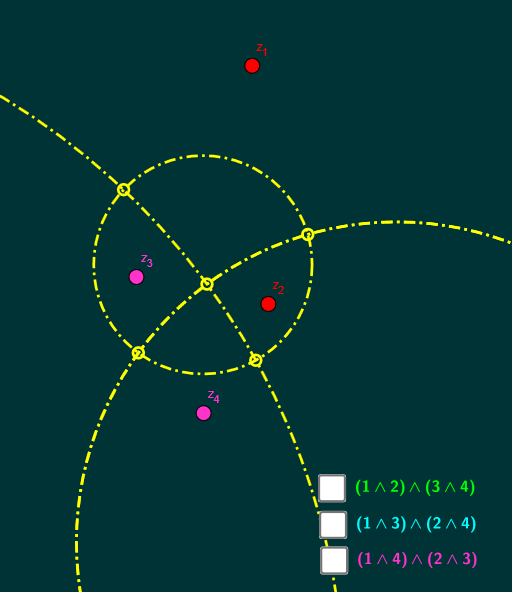
This example demonstrates how to verify the relationship of four points in normal form using geometric construction and complex number operations. Key mathematical concepts include complex numbers, geometric symmetry, and transformations. Construction involves GeoGebra commands such as LineBisector, Circle, and Tangent. Suitable for high school students or college undergraduates to learn basic geometry and complex number fundamentals.
GeoGebra Commands & Parameters
LineBisector(z_{1}, z_{2}) → l_1LineBisector(z_{3}, z_{2}) → a_3Circle(z_{3}, z_{2}, z_{1}) → t_3Tangent(z_{3}, t_3) → f_4,Circle(z_{2}, z_{3}, z_{1}) → c_{123}Tangent(z_{1}, c_{123}) → m_1,Circle(z_{3}, z_{2}, z_{4}) → c_4Tangent(z_{3}, c_4) → b_3,AngularBisector(b_3, f_4) → g_4, h_4Intersect(a_3, g_4) → H_1Circle(H_1, z_{2}) → e_4LineBisector(z_{4}, z_{1}) → l_3LineBisector(z_{3}, z_{4}) → a_1Circle(z_{3}, z_{4}, z_{1}) → c_{341}Tangent(z_{3}, c_{341}) → f_2,Circle(z_{3}, z_{4}, z_{2}) → c_{342}Tangent(z_{3}, c_{342}) → b_1,AngularBisector(b_1, f_2) → g_2, p_2Intersect(a_1, p_2) → OCircle(O, z_{3}) → cw_{34}Circle(z_{1}, z_{3}, z_{4}) → c_{1}Tangent(z_{1}, c_{1}) → n_3,Circle(z_{1}, z_{4}, z_{2}) → c_{3}Tangent(z_{1}, c_{3}) → m_3,AngularBisector(n_3, m_3) → p_3, q_3Intersect(p_3, l_3) → F_1Circle(F_1, z_{4}) → s_3Intersect(s_3, e_4) → z_o, z_{∞}, ,Circle(z_{1}, z_{2}, z_{4}) → c_{124}Tangent(z_{1}, c_{124}) → n_1,AngularBisector(m_1, n_1) → q_1, r_1Intersect(l_1, r_1) → LCircle(L, z_{1}) → s_1Intersect(s_1, cw_{34}) → z_e, z'_e, ,Line(z_{1}, z_{2}) → gfTangent(z_{3}, c_{123}) → g,Intersect(gf, g) → ACircle(z_{2}, z_{1}, z_{3}) → c_{132}Line(z_{3}, z_{4}) → hTangent(z_{1}, c_{132}) → gi,Intersect(h, gi) → BCircle(B, z_{1}) → kTangent(z_{4}, c_{124}) → n,Intersect(gf, n) → DCircle(D, z_{4}) → c4o_{12}Tangent(z_{2}, c_{123}) → b,Tangent(z_{1}, c_{123}) → d,Intersect(d, b) → m_oCircle(m_o, z_{1}) → c_{o123}If(Intersect[c_{o123}, c_{132}, 1] ≟ z_{1}, Intersect[c_{o123}, c_{132}, 2], Intersect[c_{o123}, c_{132}, 1]) → zo_4Intersect(h, gf) → ECircle(A, z_{3}) → c3o_{12}Circle(z_{3}, z_{1}, z_{4}) → c_{134}If(Intersect[c_{134}, c3o_{12}, 1] ≟ z_{3}, Intersect[c_{134}, c3o_{12}, 2], Intersect[c_{134}, c3o_{12}, 1]) → zso_4Intersect(c_{123}, c4o_{12}, 2) → z''_4Intersect(c_{123}, c4o_{12}, 1) → z'''_4If(abs(z''_4 - z_{4}) < abs(z'''_4 - z_{4}), z''_4, z'''_4) → zConz_4Tangent(z_{1}, c_{3}) → l,LineBisector(z_{3}, z_{1}) → qAngularBisector(gi, l) → s, cIntersect(q, c) → HIntersect(q, s) → ILineBisector(z_{3}, z_{4}) → f_1Tangent(z_{4}, c_{134}) → h_1,Intersect(l_1, q_1) → MCircle(M, z_{1}) → t_1Tangent(z_{1}, s_1) → i_2,Tangent(z_{1}, t_1) → j_2,LineBisector(z_{1}, z_{2}) → k_2AngularBisector(j_2, i_2) → l_2, m_2Intersect(j_2, k_2) → UIntersect(k_2, m_2) → VIntersect(k_2, l_2) → WLineBisector(z_{3}, z_{2}) → h_2LineBisector(z_{4}, z_{2}) → n_2Intersect(a_1, g_2) → NCircle(N, z_{3}) → cw'_{34}LineBisector(z'_e, z_e) → r_2Tangent(z_e, cw_{34}) → s_2,Tangent(z_e, s_1) → t_2,AngularBisector(s_2, t_2) → a_2, b_2Intersect(r_2, b_2) → RCircle(R, z_e) → w'_{12}Intersect(r_2, a_2) → SCircle(S, z_e) → w_{12}LineBisector(z_{1}, z_{3}) → g_1Tangent(z_{1}, c_{134}) → i_1,Tangent(z_{1}, c_{132}) → j_1,AngularBisector(i_1, j_1) → k_1, p_1Intersect(g_1, p_1) → JCircle(J, z_{1}) → cw_{13}Intersect(g_1, k_1) → KCircle(K, z_{1}) → cw'_{13}Circle(z_{4}, z_{2}, z_{3}) → c_{243}Circle(z_{4}, z_{2}, z_{1}) → c_{241}LineBisector(z_{4}, z_{2}) → q_2Tangent(z_{4}, c_{241}) → c_2,Tangent(z_{4}, c_{243}) → d_2,AngularBisector(d_2, c_2) → e_2, f_3Intersect(q_2, f_3) → TCircle(T, z_{2}) → cw_{24}Intersect(q_2, e_2) → ZCircle(Z, z_{2}) → cw'_{24}Intersect(cw_{24}, cw_{13}) → z_i, z'_i, ,LineBisector(z_i, z'_i) → g_3Tangent(z'_i, cw_{24}) → h_3,Tangent(z'_i, cw_{13}) → i_3,AngularBisector(i_3, h_3) → j_3, k_3Intersect(g_3, k_3) → C_1Circle(C_1, z_i) → d_3Intersect(g_3, j_3) → D_1Circle(D_1, z_i) → e_3Intersect(q_3, l_3) → E_1Circle(E_1, z_{1}) → r_3Intersect(h_4, a_3) → G_1Circle(G_1, z_{2}) → d_4LineBisector(z_o, z_{∞}) → d_1Tangent(z_o, e_4) → e_1,Tangent(z_o, s_3) → i_4,AngularBisector(i_4, e_1) → j_4, k_4Intersect(d_1, k_4) → K_1Circle(K_1, z_o) → p_4Intersect(d_1, j_4) → L_1Circle(L_1, z_o) → q_4Circle(o', e) → c_ELine(o', e) → g_xLine(o', i) → g_y
AI Drawing Prompt Reference
Draw four points and construct triangles formed by them with their circumcircles. Start with perpendicular bisectors of point pairs, then add tangents and angle bisectors, finding their intersections. Use these intersections as centers to draw circles through given points, then continue with more tangents and angle bisectors to obtain further intersections. Finally, connect some points to form lines, and find intersections of these lines with circles and tangents, revealing the geometric relationships and symmetry among the four points.
The prompt above was compiled from the original drawing commands and is for reference only.