
Rotating Circles and Angles: A Geometric Construction with Corresponding Points
Loading the math board and drawing, please wait…
In collections
Lesson 13 Rotations V2
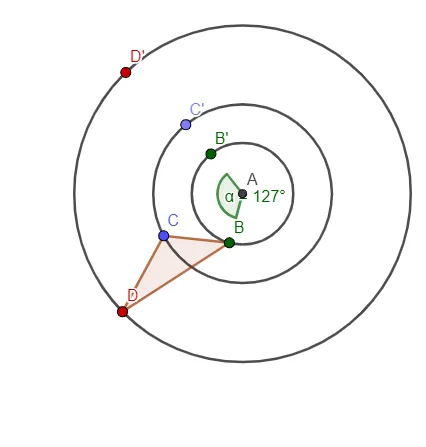
This GeoGebra example demonstrates a rotation-style geometric construction using circles, intersection points, and angle relationships, highlighting how key geometric correspondences are preserved under rotation (e.g., matching angles/constraints via rotated counterparts). The main mathematical ideas include geometric transformation (rotation), circle geometry (circles and their intersections), angle construction and measurement, and polygon-based linkage through constructed vertices. In the build, it uses Intersect to compute critical points (objects A, B, C, D and their primed counterparts), Circle to draw the involved circles (objects c, d, e), Point to place and control key locations, Polygon to connect points into the required geometric structure, and Angle to define and track the rotation-related angles (α, β, γ). The figure explicitly includes corresponding points such as B′, C′, D′ together with the original points, enabling verification of the transformation’s invariants. Suitable for middle and high school geometry, especially lessons on transformations, compass-and-straightedge style constructions, and interactive demonstrations of rotational properties.
GeoGebra Commands & Parameters
Intersect(xAxis, yAxis) → ACircle(A, B) → cCircle(A, C) → dCircle(A, D) → ePolygon(B, C, D) → t1, d_1, b, c_1Point(c) → B'Point(d) → C'Point(e) → D'Angle(B', A, B) → αAngle(C', A, C) → βAngle(D', A, D) → γ
AI Drawing Prompt Reference
Draw a coordinate plane with a rotation center at a key intersection point labeled A. Construct three circles centered at A passing through three original points B, C, and D, forming circle traces c, d, and e. From these circles, place the corresponding rotated points B′, C′, and D′ on the appropriate circle loci. Connect the original points B, C, D with a polygon to show the reference structure. At the point A, measure and label the angles between the rays AB′ and AB, between AC′ and AC, and between AD′ and AD, denoted α, β, and γ, to illustrate the angle correspondence under rotation.
The prompt above was compiled from the original drawing commands and is for reference only.