
13.3 Translate, Rotate, Reflect – Round 3 (Geometry Transformations)
Loading the math board and drawing, please wait…
In collections
Lesson 13 Rotations V2
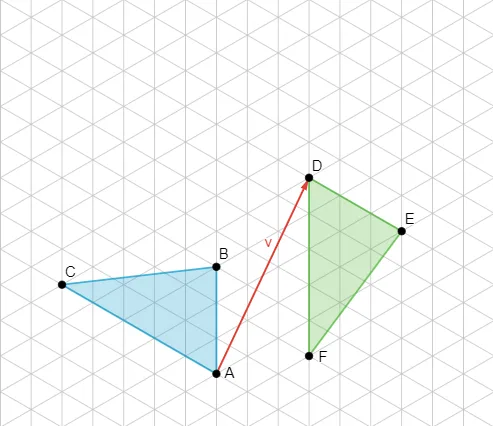
This GeoGebra example demonstrates how a configuration of points and its polygonal shape change under three fundamental transformations: translation, rotation, and reflection. It emphasizes the visual correspondence between original and transformed elements and highlights invariants such as preserved distances/structure and consistent mapping relationships. Key math concepts include vector-based translation, rotation determined by direction/angle with distance preservation, reflection across a line, and the broader viewpoint of similarity transformation by tracking how geometric quantities relate. Construction-wise, the setup uses the GeoGebra commands Polygon and Vector, together with objects representing polygon vertices (A, B, C, D, E, F) and vectors (v, t1, t2) as transformation descriptors. Additional constructed entities (c, a, b, t1, t2, f, d, e) support circular references (e.g., unit-circle/circumcircle themes) or intermediate geometric parameters needed to drive the transformations. Suitable for middle-to-high school geometry, classroom demonstrations, and self-study of transformation mappings using dynamic geometry software.
GeoGebra Commands & Parameters
Vector(A, D) → vPolygon(A, B, C) → t1, c, a, bPolygon(D, E, F) → t2, f, d, e
AI Drawing Prompt Reference
Draw a figure consisting of two triangles. The first triangle is formed by points A, B, and C. The second triangle is formed by points D, E, and F. Show how these triangles change under translation, rotation, and reflection. Keep the size and shape of the triangles unchanged, but their position and orientation will change. Focus on the correspondence between the original and transformed shapes.
The prompt above was compiled from the original drawing commands and is for reference only.