
Geometric Construction for van Aubel’s Theorem
Loading the math board and drawing, please wait…
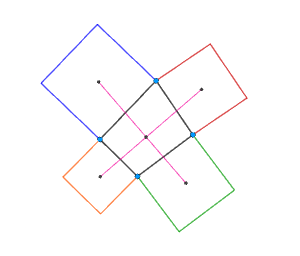
This GeoGebra example illustrates van Aubel’s theorem by building a network of points and segments inside a fixed geometric setting (often related to a circle/quad configuration) so that the theorem’s predicted length/point relationships become visible and can be checked visually. The main mathematical ideas include geometric construction in a general quadrilateral-derived configuration, using affine tools such as midpoints and centroids, and finding key intersection points to complete the structure. The construction relies on GeoGebra commands Segment and Polygon to form the basic edges and polygons, Point to define all required vertices, Midpoint and Centroid to enforce the mid/centroid constraints that drive the theorem’s relations, and Intersect to compute intersection points that determine the remaining objects. The target audience is students and learners from upper secondary through early university level, especially those studying geometry proofs, geometric constructions, and diagram-based verification of classical theorems.
GeoGebra Commands & Parameters
Segment(B, C) → gSegment(C, A) → hPolygon(C, B, 4) → poly1, i, j, k, l, D, EPolygon(A, C, 4) → poly2, m, n, p, q, F, GSegment(F, G) → sSegment(G, A) → tSegment(F, C) → aSegment(C, E) → bSegment(E, D) → cSegment(B, D) → dSegment(A, I) → fSegment(I, B) → ePolygon(I, A, 4) → poly3, f_1, g_1, h_1, i_1, K, LPolygon(B, I, 4) → poly4, j_1, k_1, l_1, m_1, M, NMidpoint(K, I) → OMidpoint(M, B) → PCentroid(poly2) → HCentroid(poly1) → JSegment(A, K) → rSegment(K, L) → n_1Segment(L, I) → p_1Segment(I, M) → q_1Segment(N, M) → r_1Segment(B, N) → s_1Segment(J, O) → t_1Segment(H, P) → a_1Point(a_1) → QIntersect(t_1, a_1) → R
AI Drawing Prompt Reference
Draw a line segment with points A and B. Create a quadrilateral C, D, E, F starting from A, and another quadrilateral G, H, I, J starting from B. Find the midpoints K and M inside the quadrilaterals, and the centroids H and J of the quadrilaterals. Connect A to K, K to L, L to I, I to M, N to M, B to N, J to O, and H to P. Then find the intersection point R between segments t_1 and a_1. This diagram illustrates geometric relationships through midpoints and centroids.
The prompt above was compiled from the original drawing commands and is for reference only.