
Roots of Unity by James R Olsen
Loading the math board and drawing, please wait…
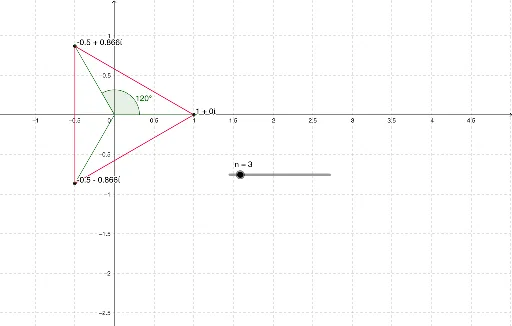
This example demonstrates the concept of roots of unity, which are the nth roots of unity on the unit circle in the complex plane, involving complex numbers and trigonometry. Using GeoGebra commands such as Sequence, Segment, and Angle, the construction of the roots of unity is dynamically illustrated. Suitable for high school mathematics education, particularly in the study of complex numbers and trigonometry.
GeoGebra Commands & Parameters
Sequence(cos(((2 * k) * π / n)) + (ί * sin(((2 * k) * π / n))), k, 0, n - 1) → list1Sequence(Segment[Element[list1, k], Element[list1, k + 1]], k, 1, n - 1) → list2Segment(Element[list1, n], Element[list1, 1]) → aSequence(Segment[(0, 0), Element[list1, j]], j, 1, n) → list3Angle(Element[list3, 1], Element[list3, 2]) → αElement(list1, A1) → B1Element(list1, A2) → B2Element(list1, A3) → B3Element(list1, A4) → B4Element(list1, A5) → B5Element(list1, A6) → B6Element(list1, A7) → B7Element(list1, A8) → B8Element(list1, A9) → B9Element(list1, A10) → B10Element(list1, A11) → B11Element(list1, A12) → B12Element(list1, A13) → B13Element(list1, A14) → B14Element(list1, A15) → B15Element(list1, A16) → B16Element(list1, A17) → B17Element(list1, A18) → B18Element(list1, A19) → B19Element(list1, A20) → B20