
Complex Numbers and Trigonometric Series
Loading the math board and drawing, please wait…
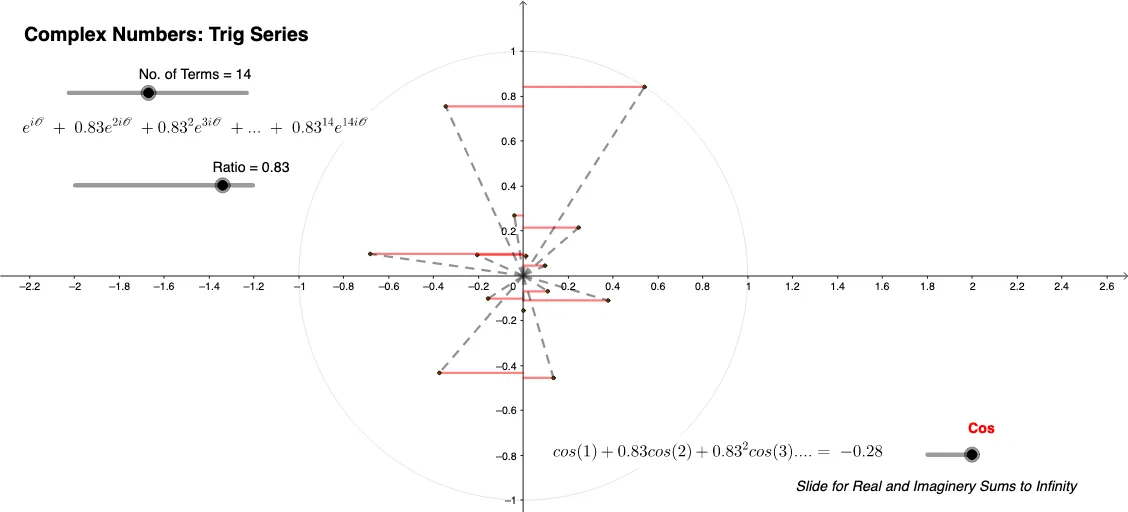
This example demonstrates the geometric representation and computation of complex numbers and trigonometric series. It involves core mathematical concepts such as complex numbers, trigonometric functions, and series summation. The construction uses GeoGebra commands like Sequence (for series) and Sum (for summation) to build trigonometric value sequences and compute their sums. Suitable for high school and above mathematics learners to visualize and understand complex numbers and trigonometric series.
GeoGebra Commands & Parameters
Sequence(((R^(a - 1) * cos(a)), (R^(a - 1) * sin(a))), a, 1, terms) → L_1Sequence(y(L_1(a)), a, 1, terms) → SinValuesSequence(x(L_1(a)), a, 1, terms) → CosValuesSum(SinValues) → SinSumSum(CosValues) → CosSumSequence(Segment[(0, y(L_1(a))), (x(L_1(a)), y(L_1(a)))], a, 1, terms) → L_2Sequence(Segment[(x(L_1(a)), 0), (x(L_1(a)), y(L_1(a)))], a, 1, terms) → L_3Sequence(Segment[(0, 0), L_1(a)], a, 1, terms) → L_4
AI Drawing Prompt Reference
Draw a graph consisting of a series of points in the complex plane, where each point's coordinates are given by powers of a radius multiplied by cosine and sine functions. Connect these points with line segments to show their relationships. The graph should clearly display the distribution of points and the connections, helping to understand the geometric meaning of complex numbers and trigonometric functions.
The prompt above was compiled from the original drawing commands and is for reference only.