
Roots of a Complex Number: Visualizing n-th Roots on the Unit Circle
Loading the math board and drawing, please wait…
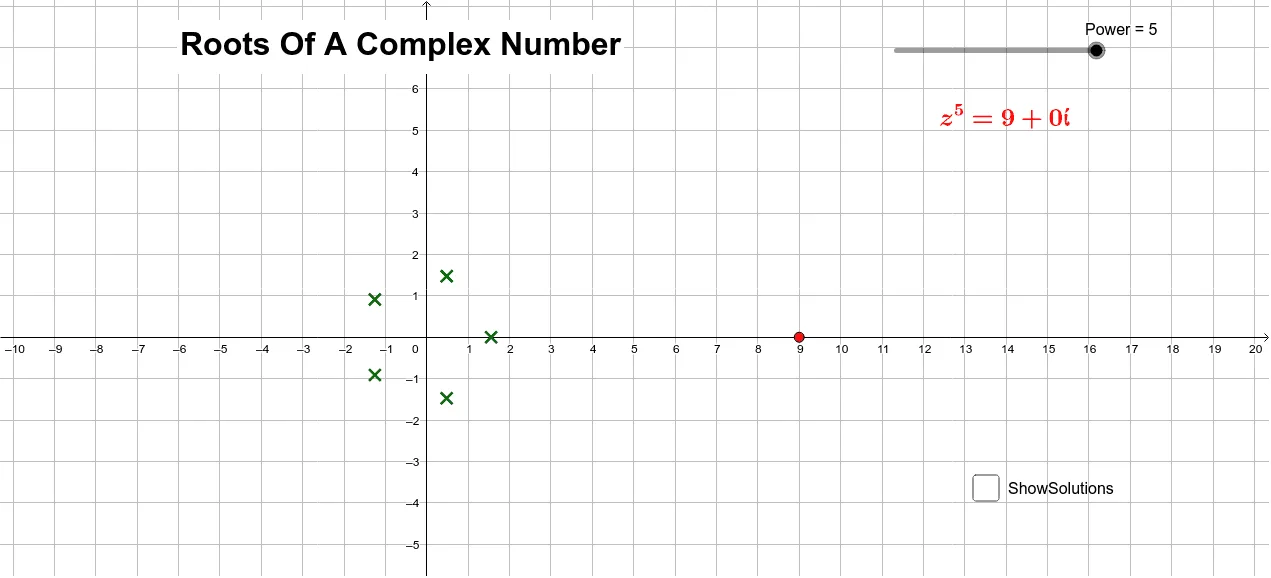
This GeoGebra example dynamically visualizes the n-th roots of a complex number in the complex plane, showing that all roots lie evenly spaced on a circle centered at the origin with radius equal to the modulus of the original number. Core mathematical concepts include polar form of complex numbers, De Moivre's theorem, roots of unity, and principal argument. Construction highlights: the Sequence command generates the root sequence; objects like z_1, a define the complex number; ModA and argA compute its modulus and argument; AbsRoots and argRoot1 derive the modulus and argument of each root; lists L_1 and L_2 connect the root points; points A, B, C, D, E mark individual roots. Suitable for high school to undergraduate students studying complex arithmetic, complex plane geometry, and trigonometric identities, as well as for teachers demonstrating the relationship between roots and the unit circle.
GeoGebra Commands & Parameters
Sequence(argRoot1 + ((k * 360) * ° / a), k, 0, a - 1) → L_1Sequence((AbsRoots; L_1(i)), i, 1, a) → L_2
AI Drawing Prompt Reference
Visualize the n-th roots of a complex number on the unit circle. First, draw a complex number z, then calculate its modulus and argument. Use the sequence command to generate the arguments of the n-th roots, compute their coordinates, and connect these root points with lines to show them on the unit circle.
The prompt above was compiled from the original drawing commands and is for reference only.