
Rhombus Diagonals by Tim Brzezinski
Loading the math board and drawing, please wait…
In collections
Expressing Geometric Properties with Equations (GPE) Cluster
Unit 7: Polygons and Quadrilaterals
Quadrilaterals
Coordinate Geometry Proof Prompts
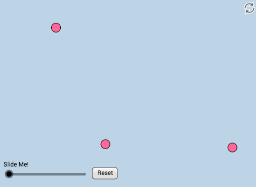
This example uses coordinate geometry to prove that the diagonals of a rhombus are perpendicular. It involves concepts such as rhombus, triangles, and ratios. Using GeoGebra commands like Circle, Line, Intersect, CircleArc, Point, Segment, Min, Dilate, Angle, Rotate, Polygon, Vector, CircleSector, it constructs a rhombus and verifies its diagonal properties. Suitable for middle school and above students learning geometric proofs.
GeoGebra Commands & Parameters
Circle(B, A) → fCircle(A, B) → cLine(A, B) → bIntersect(c, b, 2) → CCircleArc(A, B, C) → dPoint(d) → DSegment(D, B) → sCircle(D, A) → eIntersect(e, f, 2) → ESegment(A, E) → nIntersect(n, s) → LSegment(A, B) → aSegment(A, D) → gSegment(D, E) → hSegment(E, B) → iMin(g, h) → jDilate(B, If[0 < l ≤ 1, 1 - l, 0], A) → B'Segment(B, B') → mAngle(E, B, A) → αAngle(D, E, B) → βRotate(B, If[1 < l ≤ 2, ((-(l - 1)) * α), α], B) → B'_1Rotate(B', If[1 < l ≤ 2, ((-(l - 1)) * α), (-α)], B) → B''Segment(B'_1, B'') → m'Rotate(B'_1, If[2 < l ≤ 3, ((-(l - 2)) * β), (-β)], E) → JRotate(B'', If[2 < l ≤ 3, ((-(l - 2)) * β), (-β)], E) → B'''Segment(J, B''') → m''Rotate(J, If[3 < l ≤ 4, ((-(l - 3)) * α), (-α)], D) → J'Rotate(B''', If[3 < l ≤ 4, ((-(l - 3)) * α), (-α)], D) → KSegment(J', K) → m'''Circle(B, (0.2 * j)) → kCircle(E, (0.2 * j)) → pIntersect(p, m'', 1) → FIntersect(p, m', 1) → GIntersect(k, m', 1) → HIntersect(k, m, 1) → IPolygon(A, B, E, D) → poly1, a_1, b_1, e_1, d_1Dilate(B, If[5 < l ≤ 6, 6 - l, 0], D) → B'_2Vector(B, B'_2) → uDilate(E, If[7 < l ≤ 8, 8 - l, 0], A) → E'Vector(E, E') → vDilate(D, If[4 < l ≤ 5, 5 - l, 0], B) → D'Vector(D, D') → wMin(n / 2, s / 2) → oCircle(L, (0.2 * o)) → tIntersect(t, s, 2) → MIntersect(t, n, 2) → NCircleSector(L, M, N) → c_1Segment(D, D') → f_1Dilate(L, If[10 < l ≤ 11, 11 - l, 0], B) → L'Circle(D, (0.2 * j)) → h_1Intersect(k, s) → P,Intersect(s, f_1) → QIntersect(h_1, s, 1) → OCircle(A, (0.2 * j)) → k_1Intersect(k_1, m, 1) → RIntersect(k_1, n, 1) → SIntersect(k_1, m''', 1) → TIntersect(h_1, m'', 1) → UDilate(A, If[5 < l ≤ 6, 6 - l, 0], E) → A'Segment(A, A') → i_1Dilate(L, If[12 < l ≤ 13, 13 - l, 0], E) → L'_1Intersect(p, m'', 1) → VIntersect(p, n, 1) → WIntersect(p, m', 1) → ZRotate(L, If[13 < l ≤ 14, ((-(l - 13)) * π), -3.141592653589793], L) → L'_2Rotate(L', If[13 < l ≤ 14, ((-(l - 13)) * π), -3.141592653589793], L) → L''Rotate(L, If[14 < l ≤ 15, ((-(l - 14)) * π), 3.141592653589793], L) → L'_3Rotate(L'_1, If[14 < l ≤ 15, ((-(l - 14)) * π), 3.141592653589793], L) → A_1Rotate(c_1, If[6.25 < l ≤ 7.25, ((l - 6.25) * π / 2), 1.5708], L) → f_2