
Reverse-Than-Add (196) Algorithm Demo
Loading the math board and drawing, please wait…
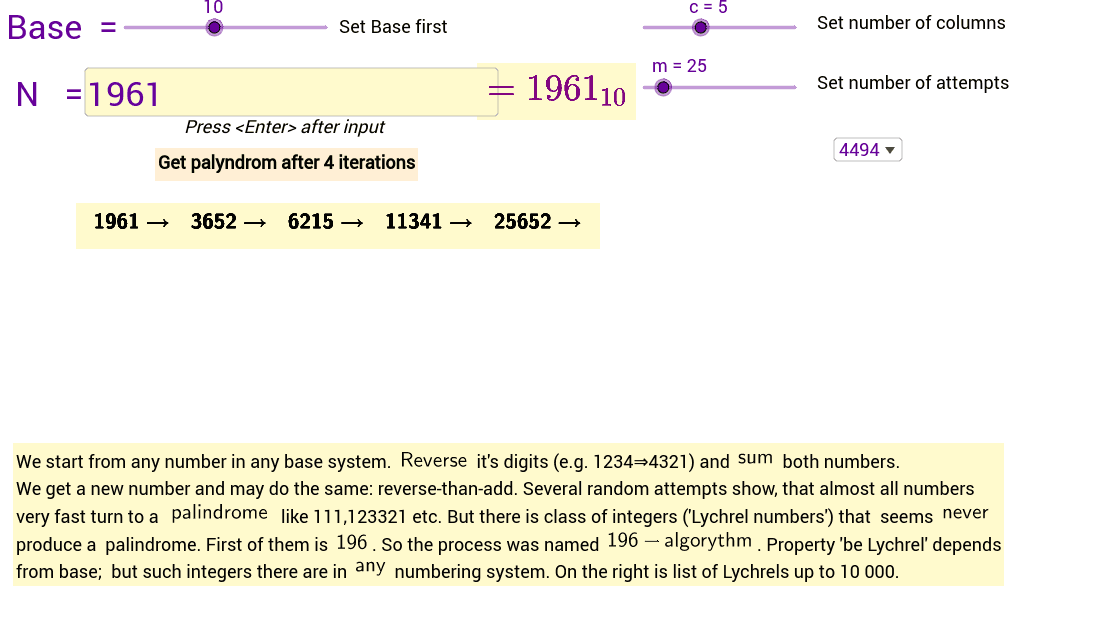
① This example demonstrates the iterative process of the reverse‑then‑add (196) algorithm, showing how any starting natural number is repeatedly reversed and added until a palindrome appears or the sequence falls into a suspected Lychrel trajectory. ② Core mathematical concepts include sequence iteration, palindrome detection, limit behavior, and the unsolved Lychrel conjecture. ③ Construction highlights: Sequence creates the iteration list; Length, ToBase, Mod, Div handle digit manipulation; Zip and Append build a text table; TableText displays the history; Textfield and InputBox provide interactive input. ④ Suitable for high‑school elective math, undergraduate discrete mathematics or introductory algorithms courses, and as a visual aid for mathematical modeling and computational thinking.
GeoGebra Commands & Parameters
Length(listIter) → lenIterToBase(N, b) → digTextLength(digText) → lenSequence(Take[digText, i, i], i, 1, len) → digsTextfield(N0) → inputBox1Min(c, lenIter) → tmpZip(If[a ≟ 0, ToBase[a, b] + "", ToBase[a, b] + "→"], a, listIter) → listTextToBase(N0, b0) → N_bMod(16, 8) → aDiv(lenIter, tmp) → tmp2Mod(lenIter, tmp) → tmp3Append(Sequence[Take[listText, (j - 1) * tmp + 1, j * tmp], j, 1, tmp2], Take[listText, lenIter - tmp3 + 1]) → matrixIterTableText(Append[Sequence[Take[listText, (j - 1) * tmp + 1, j * tmp], j, 1, tmp2], Take[listText, lenIter - tmp3 + 1]], "r") → text3
AI Drawing Prompt Reference
Visualize the iterative process of reversing and adding a natural number until a palindrome appears or a suspected Lychrel trajectory is shown, highlighting the sequence evolution, digit manipulation, and the history of iterations with key steps and results emphasized.
The prompt above was compiled from the original drawing commands and is for reference only.