
Regular Star Polygons by Denis
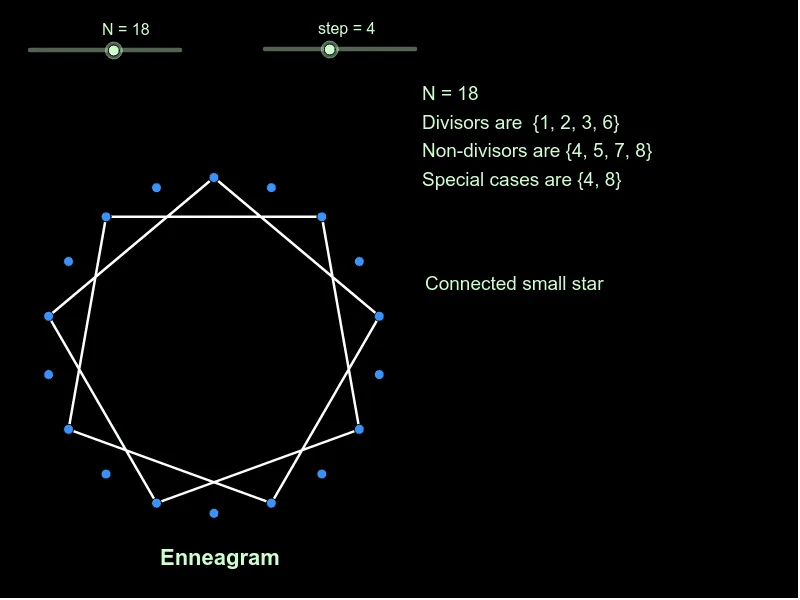
Loading the math board and drawing, please wait…
This example demonstrates the construction of regular star polygons, a special type of polygon formed by connecting vertices of a regular polygon. Key mathematical concepts include polygons, geometric construction, and sequences. It uses commands like Join, Sequence, PolyLine, etc., in GeoGebra. Suitable for middle school and above students to learn about polygons and geometric construction.
GeoGebra Commands & Parameters
Join({Sequence[Rotate[(0, 1), θ], θ, 0, 6.28319, 2 * π / n], {(0, 1)}}) → pointsSequence(k, k, 1, max) → numbsKeepIf(IsInteger[n / k], k, numbs) → divisorsPolyLine(Sequence[Element[points, j], j, 1, n + 1, 1]) → tmp1PolyLine(Sequence[Element[points, j], j, 1, n + 1, 2]) → tmp2PolyLine(Sequence[Element[points, j], j, 1, n + 1, 4]) → tmp4PolyLine(Sequence[Element[points, j], j, 1, n + 1, 5]) → tmp5PolyLine(Sequence[Element[points, j], j, 1, n + 1, 10]) → tmp10PolyLine(Sequence[Element[points, j], j, 1, n + 1, 8]) → tmp8PolyLine(Sequence[Element[points, j], j, 1, n + 1, 3]) → tmp3PolyLine(Sequence[Element[points, j], j, 1, n + 1, 11]) → tmp11PolyLine(Sequence[Element[points, j], j, 1, n + 1, 7]) → tmp7PolyLine(Sequence[Element[points, j], j, 1, n + 1, 6]) → tmp6PolyLine(Sequence[Element[points, j], j, 1, n + 1, 9]) → tmp9PolyLine(Sequence[Element[points, j], j, 1, n + 1, 14]) → tmp14PolyLine(Sequence[Element[points, j], j, 1, n + 1, 13]) → tmp13PolyLine(Sequence[Element[points, j], j, 1, n + 1, 12]) → tmp12GCD(n, step) → gcdIf(step ∈ divisors, Element[prefixes, n - 2] + "gram", Element[prefixes, n / gcd - 2] + "gram") → nameSequence(Rotate[tmp14, a], a, 0, 28 * π / n, 2 * π / n) → obj14PolyLine(Sequence[Element[points, If[Mod[j, n] ≟ 0, n, Mod[j, n]]], j, 1, 13 * (n + 1), 13]) → obj13Sequence(Rotate[tmp12, a], a, 0, 24 * π / n, 2 * π / n) → obj12Sequence(Rotate[tmp11, a], a, 0, 22 * π / n, 2 * π / n) → obj11Sequence(Rotate[tmp10, a], a, 0, 20 * π / n, 2 * π / n) → obj10Sequence(Rotate[tmp1, a], a, 0, 2 * π / n, 2 * π / n) → obj1Sequence(Rotate[tmp2, a], a, 0, 4 * π / n, 2 * π / n) → obj2Sequence(Rotate[tmp3, a], a, 0, 6 * π / n, 2 * π / n) → obj3PolyLine(Sequence[Element[points, If[Mod[j, n] ≟ 0, n, Mod[j, n]]], j, 1, 4 * (n + 1), 4]) → obj4PolyLine(Sequence[Element[points, If[Mod[j, n] ≟ 0, n, Mod[j, n]]], j, 1, 5 * (n + 1), 5]) → obj5Sequence(Rotate[tmp6, a], a, 0, 12 * π / n, 2 * π / n) → obj6PolyLine(Sequence[Element[points, If[Mod[j, n] ≟ 0, n, Mod[j, n]]], j, 1, 7 * (n + 1), 7]) → obj7PolyLine(Sequence[Element[points, If[Mod[j, n] ≟ 0, n, Mod[j, n]]], j, 1, 8 * (n + 1), 8]) → obj8Sequence(Rotate[tmp9, a], a, 0, 18 * π / n, 2 * π / n) → obj9
AI Drawing Prompt Reference
Draw regular polygons and connect their vertices to form star polygons, showing star patterns with different step lengths like 3/2, 5/2, 7/2, and rotate these patterns to display dynamic changes, finally presenting a series of rotating star polygons, emphasizing geometric construction and sequence relationships.
The prompt above was compiled from the original drawing commands and is for reference only.