
Ehrenfest's Model (Simple)
Loading the math board and drawing, please wait…
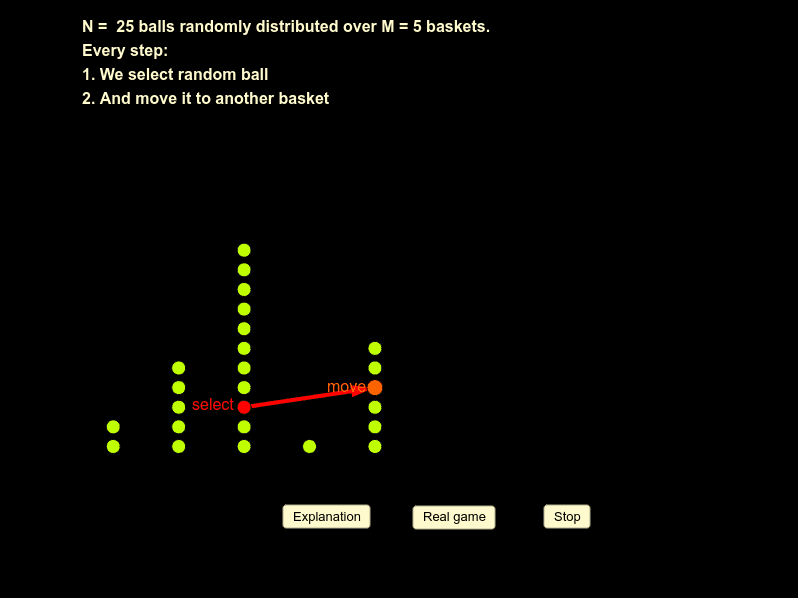
This example demonstrates the simple yet powerful Ehrenfest model proposed by Tatiana and Paul Ehrenfest in the early 1900s. It simulates a multi-urn realization to show the random transfer of particles between urns. Key math concepts include probability distributions, expected value, and random experiments. Constructed using commands like Sum, Random, Sequence, Point, Vector, LaTeX, BarChart, and objects such as n, nums, sum, etc. Suitable for high school and above learning probability & statistics and random processes.
GeoGebra Commands & Parameters
Sum(nums) → sumRandom(1, n) → iNumSequence(Sum[Take[nums, 1, k]], k, 1, m) → sumsSequence(m) → tmpSequence(Sequence[Point[{i, j * dx}], j, 1, Element[nums, i]], i, 1, m) → ballsPoint({iCrt, jCrt * dx}) → movePoint({iDel, jDel * dx}) → selectVector(Point[{iDel, jDel * dx}], Point[{iCrt, jCrt * dx}]) → vLaTeX(n, true, true) → text1BarChart(0, m, 7 * nums / n) → a
AI Drawing Prompt Reference
Draw a model showing random transfer of particles between two urns, with points representing particle positions and a bar chart displaying the distribution of particles in each urn. The model includes multiple urns, particles move randomly between them, and vectors indicate movement directions, demonstrating concepts of probability distributions and random processes.
The prompt above was compiled from the original drawing commands and is for reference only.