
Iterating x²: Exploring Boundedness of Real Number Sequences
Loading the math board and drawing, please wait…
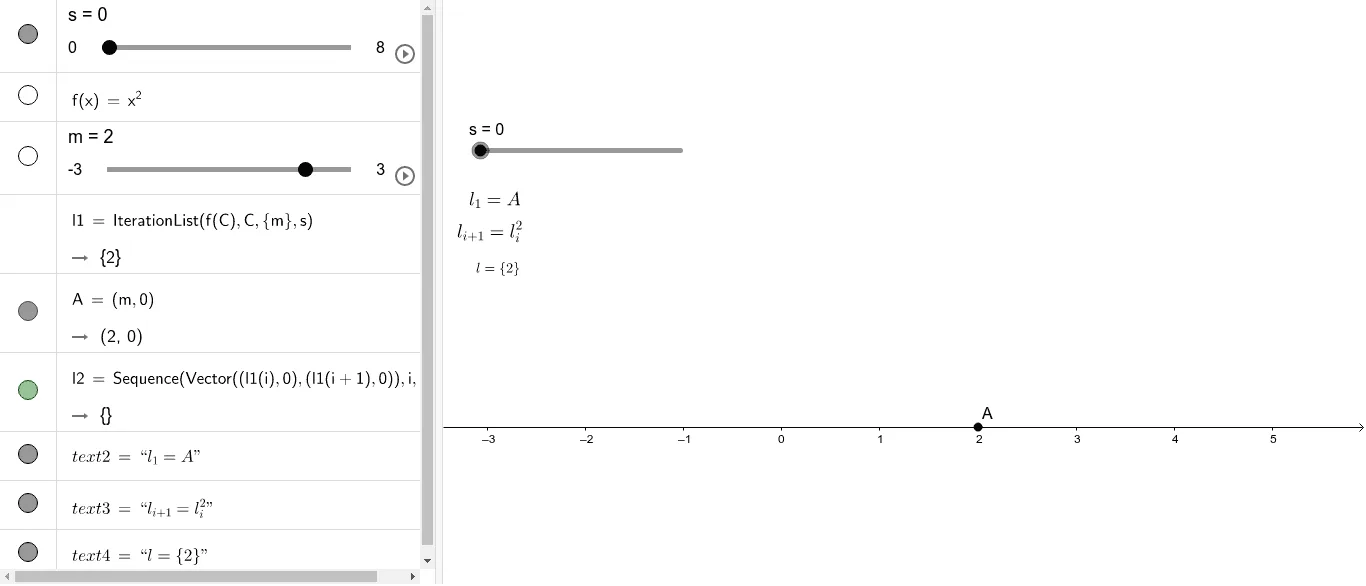
This GeoGebra example demonstrates repeated squaring of different real numbers (iterating x²) and investigates whether the resulting sequence is bounded or unbounded, visually illustrating orbit divergence or convergence under a simple nonlinear map. Core mathematical concepts include real numbers, function iteration, sequences, boundedness, limits, and introductory dynamical systems ideas. Construction highlights: the example uses GeoGebra's IterationList command to generate the iteration sequence and Sequence command to build value lists; objects such as s, f, m, l1, A, l2, and text2/text3/text4 are employed to display the iterative process and boundedness judgment. Suitable for high school advanced mathematics or undergraduate introductory analysis courses, ideal for classroom demonstrations, inquiry-based learning, and independent exploration of iteration and chaos theory.
GeoGebra Commands & Parameters
IterationList(f(C), C, {m}, s) → l1Sequence(Vector[(l1(i), 0), (l1(i + 1), 0)], i, 1, s) → l2
AI Drawing Prompt Reference
Draw a real number line with several starting points marked. For each starting point, generate a sequence of subsequent points by repeatedly squaring the value, and connect consecutive points with arrows to show the iteration path. The graphic should illustrate different behaviors: some sequences converge toward a fixed value or remain bounded, while others grow rapidly and move away from the origin, indicating unboundedness. Include multiple horizontal arrow chains for different starting values, with text labels indicating whether each sequence is bounded or unbounded. The layout should be clear, emphasizing the dynamic iteration and convergence or divergence.
The prompt above was compiled from the original drawing commands and is for reference only.