
Representing Sequences
Loading the math board and drawing, please wait…
This example demonstrates how to construct and represent sequences using GeoGebra. It involves core mathematical concepts such as sequences, geometric constructions, and conditional logic. Key GeoGebra commands and objects used include Sequence, Zip, Length, If, Element, LaTeX, Polygon, CountIf. Suitable for high school mathematics education to understand geometric representations of sequences and programming logic.
GeoGebra Commands & Parameters
Sequence((0, i), i, 20, -1, -3) → anchorFixedZip(A + (2.2 * w), A, anchorFixed) → pairAnchorsLength(leftPairs) → numPairsIf(numPairs > 0, Element[anchorFixed, numPairs], (0, 0)) → TopRowLeftSequence(Polygon[{Element[leftAnchors, i], Element[leftAnchors, i] + (3 * r), Element[leftAnchors, i] + (17 * w) + (3 * r), Element[leftAnchors, i] + (17 * w)}], i, 1, 8) → highlightBoxesLeftElement(highlightBoxesLeft, currLeft) → highlightBoxLeftSequence(Polygon[{Element[rightAnchors, i], Element[rightAnchors, i] + (3 * r), Element[rightAnchors, i] + (17 * w) + (3 * r), Element[rightAnchors, i] + (17 * w)}], i, 1, 8) → highlightBoxesRightElement(highlightBoxesRight, currRight) → highlightBoxRightZip(Text[Element[leftText, A], Element[pairAnchors, B] + w + (2.5 * r), true, true], A, leftPairs, B, Sequence[i, i, 1, Length[leftPairs]]) → leftPairDisplayZip(Text[Element[rightText, A], Element[pairAnchors, B] + (16 * w) + (2 * r), true, true], A, rightPairs, B, Sequence[i, i, 1, Length[rightPairs]]) → rightPairDisplayLaTeX((("\textcolor{#254117}{" * UnicodeToLetter[10003]) * "} ")) → cmarkLaTeX((("\textcolor{#E41B17}{" * UnicodeToLetter[10007]) * "}")) → xmarkLaTeX((((("\text{" * QUESTION) * "\\") * INSTRUCTIONS) * "}")) → allInstrucPolygon({(100, 100), (100, -100), (-100, -100), (-100, 100)}) → solutionBackgroundZip(A ≟ B, A, rightPairs, B, leftPairs) → whichCorrectCountIf(¬A, A, whichCorrect) → testLength(whichCorrect) → test2Zip(Text[If[A ≟ B, cmark, xmark], C, true, true], A, leftPairs, B, rightPairs, C, pairAnchors + (1.75 * u) + (2 * r)) → marks
AI Drawing Prompt Reference
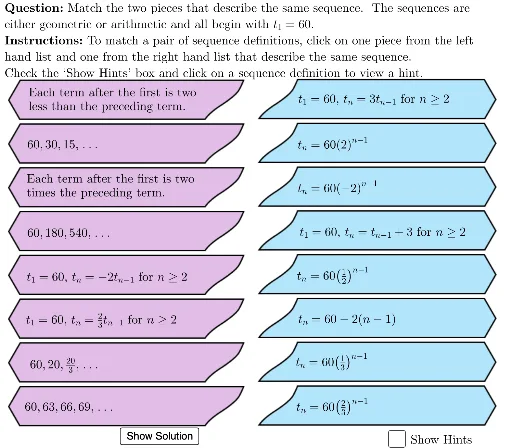
Draw a geometric diagram representing sequence pairing and matching checks. Start with a vertical column of fixed anchor points on the left, and generate corresponding paired anchors to their right. Based on these anchors, construct two sets of eight rectangular highlight boxes each, one set on the left and one on the right, corresponding to sequence elements. Place text labels inside or near the boxes to display the numeric values of the left and right sequences. In the central area, for each pair of left and right elements, draw a mark symbol: a green checkmark if the values are equal, or a red cross if they are not. Finally, place a large rectangular background area and add a text block containing a question and instructions above or inside it. The overall layout should clearly show the correspondence and judgment results.
The prompt above was compiled from the original drawing commands and is for reference only.