
Representing Fractions Part 1
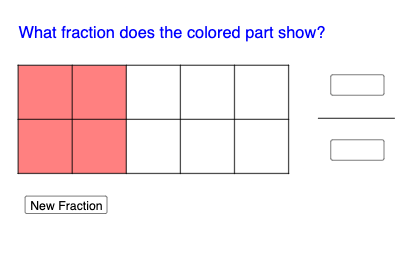
Loading the math board and drawing, please wait…
In collections
Elementary School
This example demonstrates how to visually represent fractions using geometric shapes like rhombuses, roots, tangent lines, and scalene triangles. Core math concepts include fractions, rhombuses, roots, tangent lines, scalene triangles, and subtraction. Construction involves GeoGebra commands such as Point, Segment, Random, OrthogonalLine, Intersect, Polygon, Textfield, and GCD. Suitable for middle school and above students to understand geometric representations of fractions.
GeoGebra Commands & Parameters
Point(yAxis) → APoint(xAxis) → BSegment(A, C) → fSegment(C, D) → gSegment(D, B) → hSegment(B, A) → iRandom(1, 5) → aRandom(1, 2) → bPoint(f) → FPoint(h) → HPoint(f) → IPoint(f) → JPoint(h) → LPoint(h) → MPoint(f) → OPoint(h) → PPoint(g) → QPoint(i) → SOrthogonalLine(E, h) → jOrthogonalLine(E, i) → kIntersect(k, i) → TIntersect(j, h) → UPolygon(T, B, U, E) → q1, t, b_1, u, eSegment(F, H) → lSegment(I, L) → pSegment(S, Q) → qTextfield(m) → InputBox1Textfield(n) → InputBox2Segment(O, P) → rSegment(J, M) → sSegment(V, W) → cGCD(q1, 10) → d
AI Drawing Prompt Reference
Draw a shape composed of a rhombus and triangles, including a rhombus ABCD, and line segments from points F, H, I, J, L, M, O, P, Q, S, T, U, V, W, X, Y, Z. Use random numbers to generate two fractions, and construct a quadrilateral with these points and line segments. Finally, calculate the greatest common divisor of one of the quadrilateral's sides with 10.
The prompt above was compiled from the original drawing commands and is for reference only.