
Relative Position of Two Spheres: Intersection, Tangency, and Separation
Loading the math board and drawing, please wait…
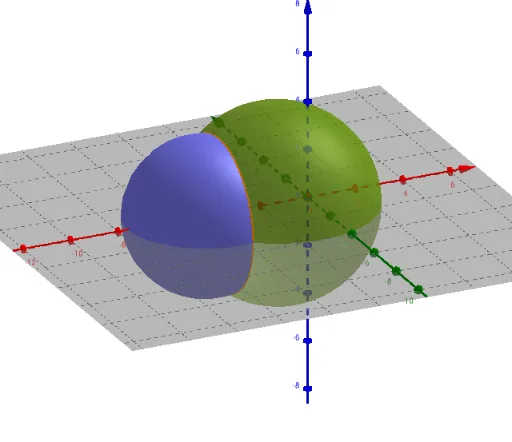
①This GeoGebra example dynamically demonstrates the possible relative positions of two spheres in 3D space, including intersecting (with a circular intersection curve), tangent (externally or internally), and disjoint cases. ②Core mathematical concepts include solid geometry, sphere equations, the nature of the intersection circle, the Pythagorean theorem applied to spatial distances, and the roles of isosceles and equilateral triangles in cross-sectional analysis; 3D vectors are used to describe center positions and distances. ③Construction highlights: from the summary, commands such as Point, Circle, Intersect, Surface, Line, Segment, Sequence, Sphere, and Distance are used to create centers A and B, radii R1 and R2, intersection points C and D, the intersection curves f1 and f2, auxiliary segments, triangles, and vectors, with sliders or parameters allowing dynamic adjustment of positions and radii. ④This is suitable for high school or early college solid geometry lessons, or math lab activities, helping students intuitively grasp spatial relationships and conditions for tangency/intersection, and enhancing spatial reasoning skills.
GeoGebra Commands & Parameters
Point(xAxis) → ACircle(A, R1) → cPoint(xAxis) → BCircle(B, R2) → dIntersect(d, c) → C, D, ,Surface(t, (f1(t) * cos(s)), (f1(t) * sin(s)), t, x(C), x(A) + R1, s, 0, (2 * π)) → aSurface(t, (f2(t) * cos(s)), (f2(t) * sin(s)), t, x(C), x(B) + R2, s, 0, (2 * π)) → bLine(D, C) → fIntersect(f, xAxis) → ESegment(E, D) → gCircle(E, g, xAxis) → eSurface(t, (f1(t) * cos(s)), (f1(t) * sin(s)), t, x(A) - R1, x(C), s, 0, (2 * π)) → hSequence(Circle[(x(C) + s, 0, 0), f1(x(C) + s), xAxis], s, 0, x(A) + R1 - x(C), 0.5) → llista_1Sphere(A, R1) → kSphere(B, R2) → lDistance(A, B) → dd