
Visualizing the Lateral Surface Area of a Cylinder
Loading the math board and drawing, please wait…
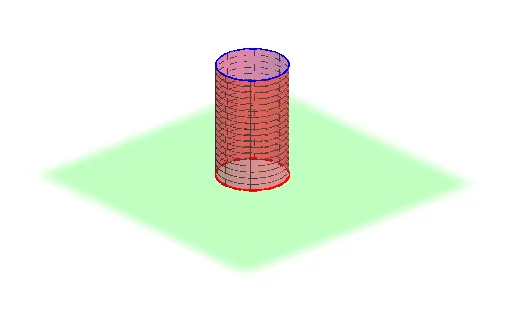
① This example demonstrates the concept of the lateral surface area of a cylinder through an interactive 3D visualization, showing how the curved surface unfolds into a rectangle to reveal the formula's geometric basis. ② Core mathematical concepts include cylinder geometry, lateral surface area calculation (2πrh), surface unfolding, vector representation, and area measurement in 3D space. ③ Construction highlights: using GeoGebra commands such as Circle, Cylinder, CurveCartesian, Segment, and Surface to build the cylinder and its lateral face; sliders (a, b, i) and a button (button1) control parameters to animate the unfolding; vectors and trajectory objects help illustrate the relationship between circumference and area. ④ Suitable for middle school geometry, introductory college solid geometry, and for teachers creating interactive lessons to help students grasp the derivation of the cylinder's lateral area formula through hands-on exploration.
GeoGebra Commands & Parameters
Circle(A, r) → cCylinder(c, h) → cyl, upperBase, lateralSurfaceCurveCartesian((r * cos(t)), (r * sin(t)), t, 0, tt) → luk1Segment(Q1, P1) → gCurveCartesian(ff(t), gg(t), t, 0, d / r) → Trajectory1CurveCartesian((r * cos(t)), ((-r) * sin(t)), t, 0, tt) → luk2CurveCartesian(ff(t), (-gg(t)), t, 0, d / r) → Trajectory2Surface((r * cos(t)), (r * sin(t)), s, t, 0, tt, s, 0, h) → cylSurf0Surface(x(Q1) + (x(q1p1) * t), y(Q1) + (y(q1p1) * t), s, t, 0, 1, s, 0, h) → cylSurf1Segment(A, A + (r, 0)) → radius
AI Drawing Prompt Reference
Visualize a cylinder with its lateral surface unfolding into a rectangle to demonstrate the geometric basis of the lateral surface area formula 2πrh. Include the cylinder, its circular base, the unrolled rectangular lateral surface, line segments connecting the top and bottom, and trajectories showing how the lateral surface unfolds. Use sliders to control the cylinder's radius and height, animate the unfolding process, and represent the relationship between the circumference and area with vectors.
The prompt above was compiled from the original drawing commands and is for reference only.