
Relationships Between Pentagon, Decagon, and Icosahedron
Loading the math board and drawing, please wait…
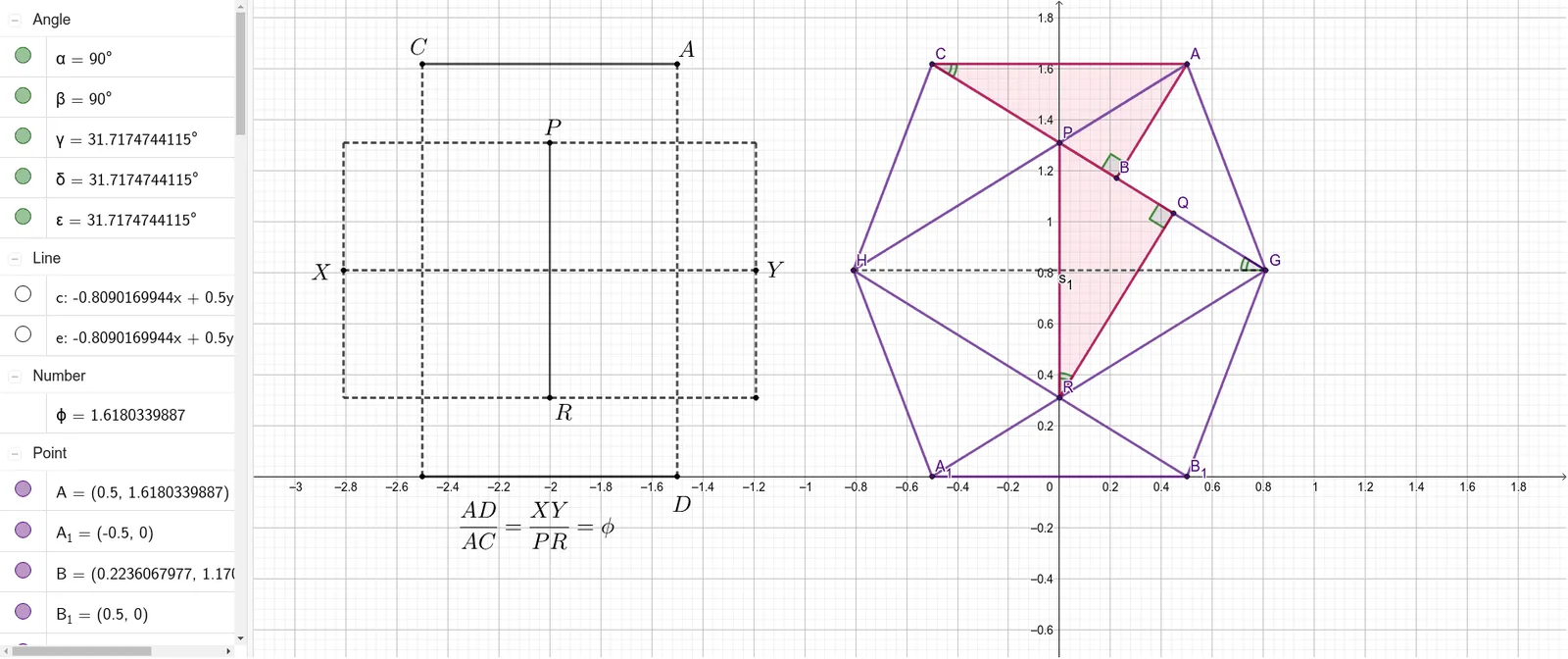
This example illustrates the relationships between a pentagon, a decagon, and an icosahedron. Key mathematical concepts include polygons, angles, and solid geometry. Using GeoGebra commands such as Segment, Polygon, and Intersect, these shapes can be constructed and their geometric relationships observed. Suitable for high school geometry education and students learning solid geometry.
GeoGebra Commands & Parameters
Segment(C, A) → fSegment(A, G) → gSegment(G, B_1) → hSegment(B_1, A_1) → iSegment(A_1, H) → jSegment(H, C) → kSegment(A, P) → lSegment(P, H) → mSegment(C, P) → nSegment(P, G) → pSegment(G, R) → qSegment(H, R) → rSegment(R, A_1) → sSegment(R, B_1) → tSegment(P, R) → bOrthogonalLine(A, p) → cIntersect(c, p) → BSegment(A, B) → dOrthogonalLine(R, p) → eIntersect(e, p) → QSegment(R, Q) → f_1Segment(N, M) → aSegment(M, K) → g_1Segment(K, L) → h_1Segment(L, N) → i_1Segment(T, S) → j_1Segment(T, Q_1) → k_1Segment(Q_1, R_1) → l_1Segment(R_1, S) → m_1Segment(T - (0, 1 / 2), Q_1 - (0, 1 / 2)) → n_1Intersect(j_1, n_1) → UIntersect(n_1, l_1) → VSegment(O, P_1) → p_1Polygon(C, B, A) → t1, a_1, c_1, b_1Polygon(R, Q, P) → t2, p_2, r_1, q_1Segment(H, G) → s_1Angle(A, B, C) → αAngle(P, Q, R) → βAngle(B, C, A) → γAngle(P, G, H) → δAngle(Q, R, P) → ε
AI Drawing Prompt Reference
Draw a regular pentagon, a regular decagon, and a regular icosahedron. Start by drawing three sides of the pentagon, then use perpendicular lines and intersections to construct the vertices of the decagon. Next, draw two faces of the icosahedron. Finally, measure and label the interior angles of the pentagon and decagon, as well as the vertex angles of the icosahedron.
The prompt above was compiled from the original drawing commands and is for reference only.