
Relationship Between Diagonals of a Parallelogram
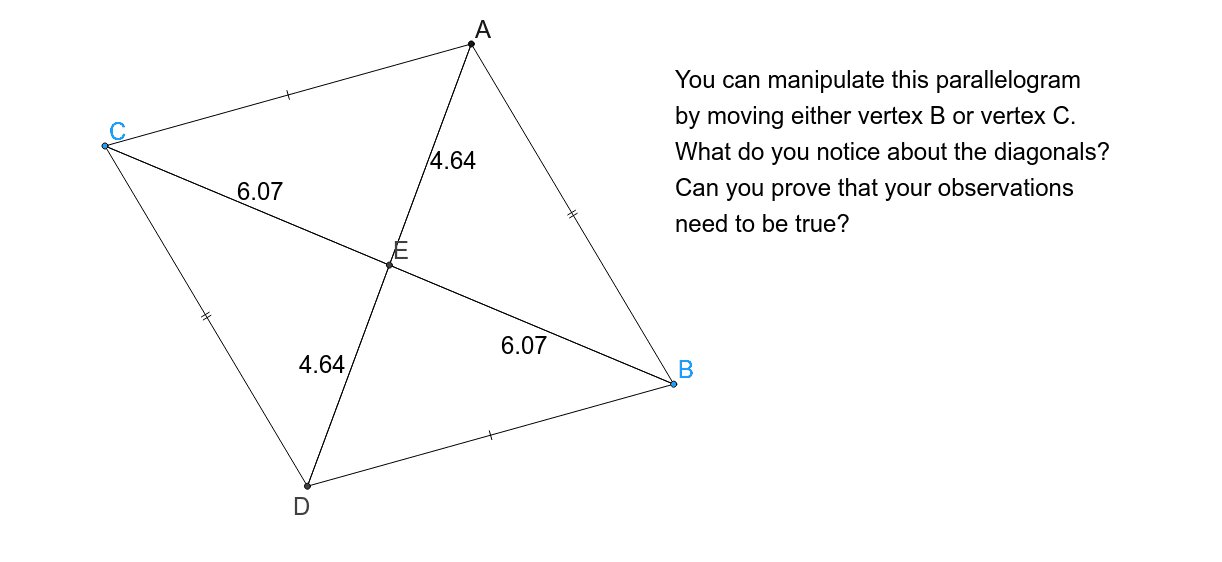
Loading the math board and drawing, please wait…
In collections
Parallelogram Explorations
This example demonstrates that the diagonals of a parallelogram seem to bisect each other. Students can explore this property by constructing and measuring, and try to prove it. The example involves geometric construction, using commands such as point, line, intersection, segment, slope, and angle. Suitable for middle school and above students to learn geometry and proof.
GeoGebra Commands & Parameters
Point(yAxis) → APoint(xAxis) → BLine(A, C) → aLine(B, a) → bLine(A, B) → cLine(C, c) → dIntersect(b, d) → DSegment(A, C) → eSegment(B, D) → fSegment(A, B) → gSegment(C, D) → hSlope(a) → m1Slope(b) → m2Line(C, D) → iSlope(i) → m3Line(A, B) → jSlope(j) → m4Segment(C, B) → kAngle(A, B, C) → αAngle(D, C, B) → βAngle(C, B, D) → γAngle(B, C, A) → δAngle(C, A, B) → εAngle(B, D, C) → ζAngle(D, C, A) → ηAngle(A, B, D) → θSegment(D, A) → lIntersect(k, l) → ESegment(E, A) → mSegment(E, D) → nSegment(E, C) → pSegment(E, B) → q
AI Drawing Prompt Reference
Draw a parallelogram to demonstrate that its diagonals appear to bisect each other. Start by sketching two intersecting lines, then connect the intersection point to points on each line to form the parallelogram. Locate the intersection of the diagonals and measure to check if they are bisected. Optionally, verify the property by measuring angles and calculating slopes.
The prompt above was compiled from the original drawing commands and is for reference only.