
Exploring Interior Angles of Parallelograms
Loading the math board and drawing, please wait…
In collections
Parallelogram Explorations
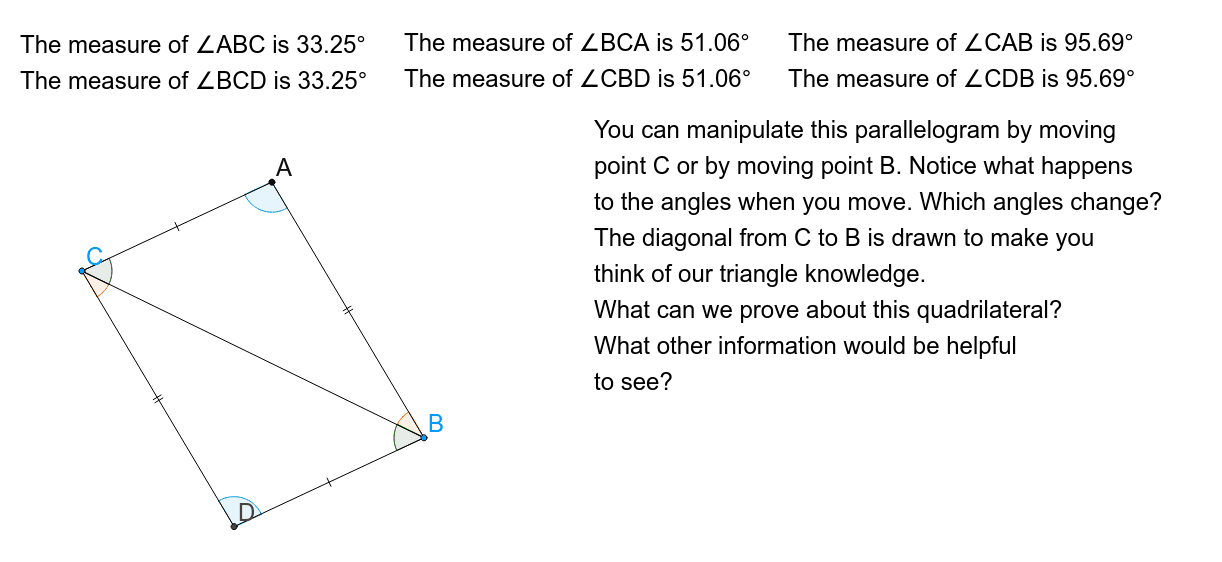
This example demonstrates the properties of interior angles in a parallelogram by allowing students to observe changes as they manipulate the diagonal. Key math concepts include parallelogram properties, angle sum theorem, and diagonal relationships. Constructed using GeoGebra commands like Point, Line, Intersect, Segment, Slope, and Angle. Suitable for middle school and above, ideal for visual geometry teaching and concept reinforcement.
GeoGebra Commands & Parameters
Point(yAxis) → APoint(xAxis) → BLine(A, C) → aLine(B, a) → bLine(A, B) → cLine(C, c) → dIntersect(b, d) → DSegment(A, C) → eSegment(B, D) → fSegment(A, B) → gSegment(C, D) → hSlope(a) → m1Slope(b) → m2Line(C, D) → iSlope(i) → m3Line(A, B) → jSlope(j) → m4Segment(C, B) → kAngle(A, B, C) → αAngle(D, C, B) → βAngle(C, B, D) → γAngle(B, C, A) → δAngle(C, A, B) → εAngle(B, D, C) → ζ
AI Drawing Prompt Reference
Draw a parallelogram with its diagonals, labeling all four interior angles. Allow the diagonals to be manipulated to observe the sum of interior angles and relationships between adjacent angles. Start by drawing two intersecting lines, find their intersection point, and connect the opposite vertices to form the parallelogram. Label the vertices and interior angles, and display the diagonals.
The prompt above was compiled from the original drawing commands and is for reference only.