
Parallelograms #1 - Parallel Sides
Loading the math board and drawing, please wait…
In collections
Parallelogram Explorations
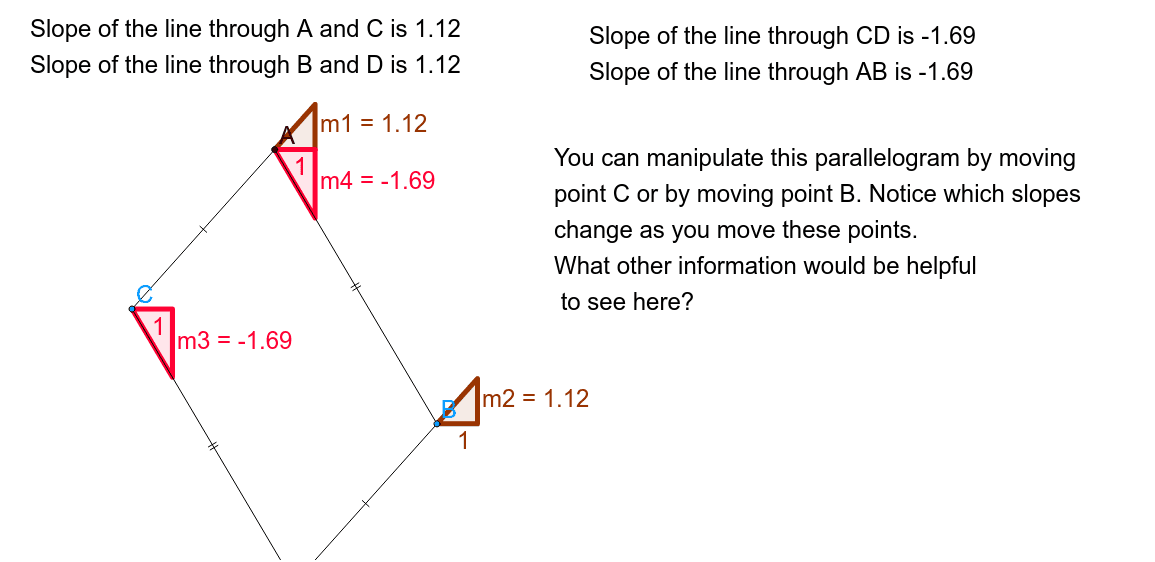
① This dynamic sketch demonstrates the defining property of a parallelogram: opposite sides are parallel, using a draggable quadrilateral. ② Core math concepts include the definition of a parallelogram, parallel lines, and slope equality as an algebraic criterion for parallelism. ③ Construction details: Points A, B, C, D define the quadrilateral; segments a, b, c, d form the sides; lines and intersection points are used; slopes m1, m2, m3, m4 are computed via the Slope command and displayed as text to show that opposite slopes are equal. ④ Suitable for middle school geometry lessons or high school coordinate geometry, serving as an interactive demonstration for students to explore the properties of parallelograms and verify them through slope calculations.
GeoGebra Commands & Parameters
Point(yAxis) → APoint(xAxis) → BLine(A, C) → aLine(B, a) → bLine(A, B) → cLine(C, c) → dIntersect(b, d) → DSegment(A, C) → eSegment(B, D) → fSegment(A, B) → gSegment(C, D) → hSlope(a) → m1Slope(b) → m2Line(C, D) → iSlope(i) → m3Line(A, B) → jSlope(j) → m4
AI Drawing Prompt Reference
Draw a draggable quadrilateral with both pairs of opposite sides parallel, demonstrating the defining property of a parallelogram. Start by placing one point on the y-axis and another on the x-axis. Through the y-axis point, draw a line; through the x-axis point, draw a line parallel to it. Connect the two initial points with a segment, then through the y-axis point draw a line parallel to that segment. The intersection of these two parallel lines gives the fourth vertex. Connect all four vertices to form the quadrilateral, and draw its two diagonals. Compute and display the slopes of all four sides as text, so that opposite slopes are visibly equal.
The prompt above was compiled from the original drawing commands and is for reference only.