
Fraction Addition: Visualizing Sum of Unlike Fractions with Rectangular Grids an
Loading the math board and drawing, please wait…
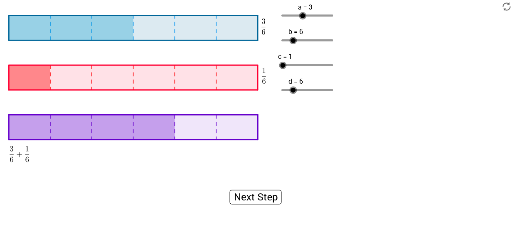
This GeoGebra example demonstrates the addition of fractions with different denominators through an interactive visual model. It uses rectangular partitions and special points on a number line to turn abstract fraction arithmetic into tangible area and length comparisons. Core mathematical concepts include fractions, common denominators, least common multiple (LCM), greatest common divisor (GCD), the rectangle area model, and point-to-number correspondence on a number line. Construction highlights: Point creates key vertices, Polygon builds multiple rectangular regions, LCM and GCD compute the common denominator, Sequence generates equal subdivisions, and Intersection with Symmetry locates fraction positions on the number line. The final result is shown by linking multiple rectangles (poly1 to poly4) and points (A through P). This resource is ideal for upper elementary and middle school students learning fraction operations, and for teachers demonstrating the geometric meaning of common denominators and number-line representation.
GeoGebra Commands & Parameters
Point(Circle[A, 1]) → BPolygon(A, B, C, D) → poly1, a_1, b_1, c_1, d_1Point(Circle[E, 10]) → FPolygon(E, F, G, H) → poly2, e, f, g, hPolygon(I, J, K, L) → poly3, i, j, k, lPolygon(A, B, M, N) → poly4, a_2, b_2, m, nPolygon(H, E, O, P) → poly5, h_1, e_1, o, pPolygon(I, J, Q, R) → poly6, i_1, j_1, q, rLCM(b, d) → sSequence(Segment[(((10 * i)) / b, 0), (((10 * i)) / b, 1)], i, 1, b - 1) → list1Sequence(Segment[(((10 * i)) / d, -1), (((10 * i)) / d, -2)], i, 1, d - 1) → list2GCD(g_1, s) → l_1Polygon(K, L, T, S) → poly7, k_2, l_2, t_1, s_1Sequence(Segment[(((10 * i)) / s, -3), (((10 * i)) / s, -4)], i, 1, s) → list3Sequence(Segment[(((10 * i)) / n_1, -3), (((10 * i)) / n_1, -4)], i, 1, n_1 - 1) → list4Sequence(Segment[(((10 * i)) / s, -3), (((10 * i)) / s, -4)], i, 1, (2 * s)) → list3_1Sequence(Segment[((10 * i / n_1), -3), ((10 * i / n_1), -4)], i, 1, (2 * n_1) - 1) → list4_1Sequence(((10 * i / s), -3), i, 1, s) → list5_2Sequence(((10 * i / n_1), -3), i, 1, n_1) → list5_1Sequence(((10 * i / n_1), -4), i, 1, n_1) → list6_1Sequence(((10 * i / s), -4), i, 1, s) → list6_2Sequence(((10 * i / s), -3), i, 1, (2 * s) - 1) → list5_4Sequence(((10 * i / n_1), -3), i, 1, (2 * n_1) - 1) → list5_3Sequence(((10 * i / n_1), -4), i, 1, (2 * n_1) - 1) → list6_3Sequence(((10 * i / s), -4), i, 1, (2 * s) - 1) → list6_4Sequence(Segment[list5(i), list6(i)], i, 1, s - n_1) → list7Sequence(Segment[list5_5(i), list6_5(i)], i, 1, (2 * s) - (2 * n_1)) → list7_1