
Regular Octahedron (6 Vertices) on a Sphere
Loading the math board and drawing, please wait…
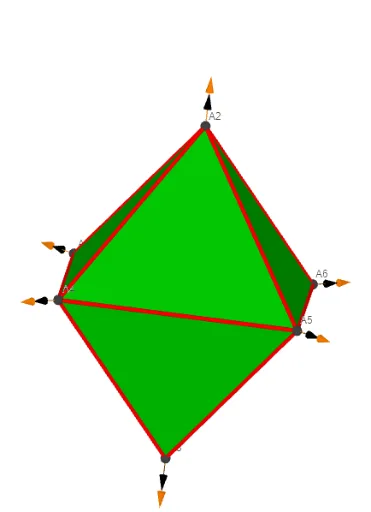
This GeoGebra example demonstrates the 3D construction of a regular octahedron by explicitly placing its six vertices in space and highlighting the geometric relationship to a surrounding sphere. It connects to core ideas in solid geometry and spatial visualization: regular polyhedra, vertex/edge construction, and the concept that all selected vertices lie on the same sphere. Key construction points derived from the provided command summary include Sphere (to create the spherical reference surface), point sets such as Points00 and multiple named point objects (e.g., Um1, bo1–bo10, bo4–bo9) for the octahedron’s vertices, and Segments to connect vertices into the polyhedron’s edges. Text and TableText are used for labeling (e.g., vertex indices or parameters), while UnicodeToLetter and utilities like Sum/Zip support auxiliary text/data organization. Suitable for upper-secondary to early university students, for teaching solid geometry, vectors/coordinate point interpretation, and geometry-based modeling and exploration.
GeoGebra Commands & Parameters
UnicodeToLetter(34) → u34Text("" + Um1) → txt_pSum(Flatten[Sequence[Append[Sequence[Element[txt_p, i], i, m01(k), m02(k)], " "], k, 1, 5]]) → txtUm1Zip(Vector[a, a + UnitVector[a]], a, Points00) → lVector1Zip(Vector[a, a + (1.5 * UnitVector[b])], a, Points00, b, Wi_Pc) → lVector2Zip(Vector[a, a + (1.5 * UnitVector[b])], a, Points00, b, Wi_P) → lVector3Sphere((0, 0, 0), 5) → sphTableText(Append["i", 1…n], Append[" \fgcolor{orange}{GM :Δφ_i}, rad", l1w], Append["\fgcolor{magenta}{GC :Δφ_i} , rad", l1cw], "v") → text23rZip(Segment[Element[Points00, y(a)], Element[Points00, z(a)]], a, ll1bb(1)) → ll1Zip(Segment[Element[Points00, y(a)], Element[Points00, z(a)]], a, ll1bb(2)) → ll2
AI Drawing Prompt Reference
Draw a regular octahedron on a sphere, with its six vertices explicitly placed in space, highlighting the geometric relationship to the surrounding sphere. First, create a sphere centered at the origin with a radius of 5 as the reference surface. Then, place six vertices on the sphere and connect them with line segments to form the edges of the octahedron. Label each vertex with text and use vector tools to show the spatial positions of the vertices, suitable for teaching the concepts of regular polyhedra, vertex-edge construction, and the idea that all selected vertices lie on the same sphere.
The prompt above was compiled from the original drawing commands and is for reference only.