
Reflection in a Circle: Geometric Construction and Mathematical Concepts
Loading the math board and drawing, please wait…
In collections
Transformations and Symmetry
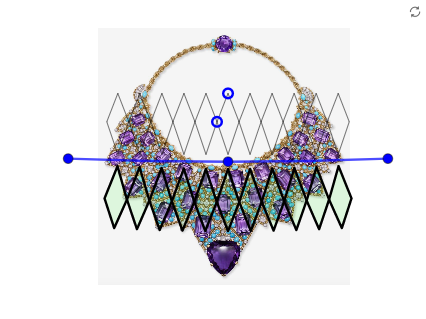
This example demonstrates the reflection phenomenon within a circle, using geometric construction methods to illustrate reflection principles. Key mathematical concepts include circle, reflection, coordinate geometry, and transformation. Construction involves GeoGebra commands such as Intersect, Point, Polygon, CircumcircleArc, and Mirror. Suitable for middle or high school mathematics courses to understand geometric transformations and properties of circles.
GeoGebra Commands & Parameters
Intersect(xAxis, yAxis) → APoint(yAxis) → CPolygon(A, B, C, D) → q1, a, b, c, dSequence(Polygon[Translate[A, Vector[(u * Vector[B, D])]], Translate[B, Vector[(u * Vector[B, D])]], Translate[C, Vector[(u * Vector[B, D])]], Translate[D, Vector[(u * Vector[B, D])]]], u, -5, 5) → l1Point(yAxis) → FCircumcircleArc(E, F, G) → eMirror(l1, e) → l1'Mirror(l1, e) → l1'_{1}
AI Drawing Prompt Reference
Draw a circle and a quadrilateral inside it, connecting the origin of the coordinate axes to each vertex of the quadrilateral. Extend lines from the origin along these connections to form a series of parallelograms. Then, take another point outside the circle, connect two opposite vertices of the quadrilateral to this point to draw an arc. Finally, reflect the parallelograms across the arc to demonstrate symmetry transformation.
The prompt above was compiled from the original drawing commands and is for reference only.