
Reciprocal Trig Ratios
Loading the math board and drawing, please wait…
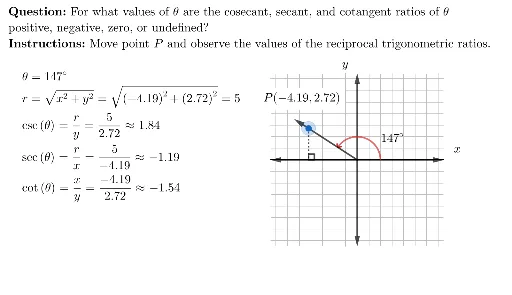
This example demonstrates the concept of reciprocal trigonometric ratios. It constructs angles and trigonometric values to help students understand the properties of cosecant, secant, and other reciprocal ratios. It uses commands like Sequence, Zip, Point, and others, suitable for high school math education.
GeoGebra Commands & Parameters
Sequence(i, i, 0, 357, 3) → angleMeasuresZip(((5 * cos(A°)), (5 * sin(A°))), A, angleMeasures) → pointListPoint(pointList) → PIndexOf(P, pointList) → currIndxIf(x(P) ≠ 0, 5 / x(P)) → D4UnicodeToLetter(10007) → xmarkUnicodeToLetter(10003) → cmarkSegment(P, (x(P), 0)) → VerticalLineVector((0, 0), (qWidth, 0)) → hAxisRotate(hAxis, π, (0, 0)) → hAxis2Rotate(hAxis, π / 2, (0, 0)) → vAxisRotate(hAxis, (3 * π / 2), (0, 0)) → vAxis2Element(angleMeasures, currIndx) → currAngleZip(Rotate[A, currAngle°, (0, 0)], A, {(1.8, -0.2), (2, 0), (2.2, -0.2)}) → chevronPointsSequence(Segment[Element[chevronPoints, i], Element[chevronPoints, i + 1]], i, 1, 2) → chevronIf((5 / y(P) * 100) ≟ (round(5 / y(P), 2) * 100), " = ", " \approx ") → cscEqualityIf(y(P) ≟ 0, "\text{undefined}", (("\(" * 5 / y(P)) * "\)")) → cscFinalFmtLaTeX(((((("\text{\csc(\theta) = \dfrac{\(r\)}{\(y\)} = \dfrac{\(5\)}{\(" * y(P)) * "\)}") * cscEquality) * cscFinalFmt) * "}")) → cscStrIf((5 / x(P) * 100) ≟ (round(5 / x(P), 2) * 100), " = ", " \approx ") → secEqualityIf(x(P) ≟ 0, "\text{undefined}", (("\(" * 5 / x(P)) * "\)")) → secFinalFmtLaTeX(((((("\text{\sec(\theta) = \dfrac{\(r\)}{\(x\)} = \dfrac{\(5\)}{\(" * x(P)) * "\)}") * secEquality) * secFinalFmt) * "}")) → secStrIf((x(P) / y(P) * 100) ≟ (round(x(P) / y(P), 2) * 100), " = ", " \approx ") → cotEqualityIf(y(P) ≟ 0, "\text{undefined}", (("\(" * x(P) / y(P)) * "\)")) → cotFinalFmtLaTeX(((((((("\text{\cot(\theta) = \dfrac{\(x\)}{\(y\)} = \dfrac{\(" * x(P)) * "\)}{\(") * y(P)) * "\)}") * cotEquality) * cotFinalFmt) * "}")) → cotStrTableText({{thetaStr, rStr, cscStr, secStr, cotStr}}, "vl") → displayDataCurveCartesian((2 * cos(((2 * π) * t))), (2 * sin(((2 * π) * t))), t, 0, currAngle / 360) → angleCurvePolygon({(0, 0), (0, 0.5), (0.5, 0.5), (0.5, 0)}) → angleBoxTemplateElement(angleMeasures, currIndx) → testTranslate(angleBoxTemplate, (If[x(P) > 0, x(P) - 0.5, x(P)], If[y(P) < 0, -0.5, 0])) → angleBox