
Trig Circle Start: Multiples of 30°
Loading the math board and drawing, please wait…
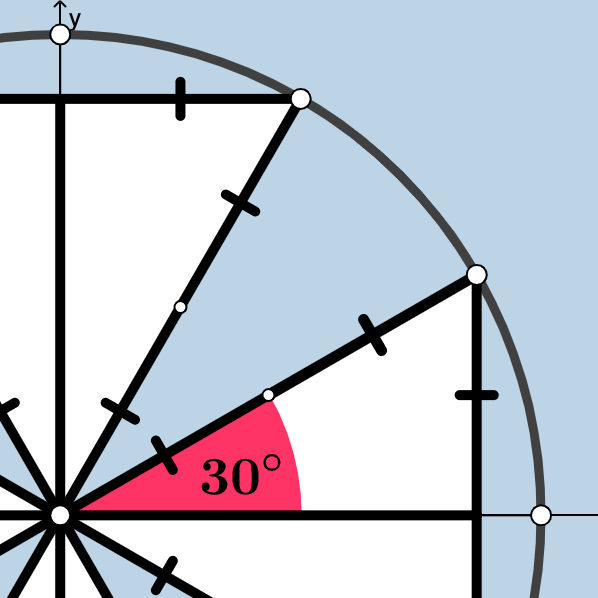
This example demonstrates the trigonometric values for multiples of 30° on the unit circle. It involves core concepts like angles, the unit circle, sine, cosine, and special angles. GeoGebra commands used include Mirror, Intersect, Dilate, Segment, Polygon, Midpoint, Rotate, Circle, Line, CircleSector, Vector, and Translate. It is suitable for high school students to learn and understand the relationship between trigonometric functions and the unit circle, ideal for classroom instruction or self-study.
GeoGebra Commands & Parameters
Mirror(G, f) → G'Mirror(F, f) → F'Mirror(E, g) → E'Mirror(F, g) → F'_1Mirror(G, g) → G'_1Mirror(F', g) → F''Mirror(G', g) → G''Mirror(E, f) → E'_1Mirror(E'_1, g) → HIntersect(g, j) → IIntersect(g, i) → JIntersect(g, h) → KDilate(L, If[0 < a ≤ 1, 1 - a, 0], K) → L'Segment(L, L') → kDilate(K, If[1 < a ≤ 2, 2 - a, 0], E) → K'Segment(K, K') → lPolygon(L, K, E) → poly1, e, l_1, k_1Midpoint(L, E) → MDilate(E, If[2 < a ≤ 3, 3 - a, 0], M) → E'_2Segment(E, E'_2) → mDilate(M, If[3 < a ≤ 4, 4 - a, 0], L) → M'Segment(M, M') → nRotate(K, If[4 < a < 5, ((-(a - 4)) * pi / 3), ((-pi)) / 3], E) → K'_1Rotate(K', If[4 < a < 5, ((-(a - 4)) * pi / 3), ((-pi)) / 3], E) → K''Segment(K'_1, K'') → l'Rotate(K'_1, If[5 < a < 6, ((-(a - 5)) * pi), (-pi)], M) → NRotate(K'', If[5 < a < 6, ((-(a - 5)) * pi), (-pi)], M) → K'''Segment(N, K''') → l''Rotate(L, If[6 < a < 7, ((a - 6) * pi / 2), pi / 2], L) → L'_1Rotate(K, If[6 < a < 7, ((a - 6) * pi / 2), pi / 2], L) → K'_2Rotate(E, If[6 < a < 7, ((a - 6) * pi / 2), pi / 2], L) → E'_3Polygon(L'_1, K'_2, E'_3) → poly1', e'_3, l'_1, k'_2Rotate(K, If[6 < a < 7, ((a - 6) * pi / 2), pi / 2], L) → K'_3Rotate(K', If[6 < a < 7, ((a - 6) * pi / 2), pi / 2], L) → K''_1Segment(K'_3, K''_1) → l'_2Rotate(L, If[6 < a < 7, ((a - 6) * pi / 2), pi / 2], L) → L'_2Rotate(L', If[6 < a < 7, ((a - 6) * pi / 2), pi / 2], L) → L''Segment(L'_2, L'') → k'Rotate(K'_1, If[6 < a < 7, ((a - 6) * pi / 2), pi / 2], L) → ORotate(K'', If[6 < a < 7, ((a - 6) * pi / 2), pi / 2], L) → K'''_1Segment(O, K'''_1) → l''_1Rotate(N, If[6 < a < 7, ((a - 6) * pi / 2), pi / 2], L) → N'Rotate(K''', If[6 < a < 7, ((a - 6) * pi / 2), pi / 2], L) → PSegment(N', P) → l'''Rotate(L'_1, If[7 < a < 8, ((a - 7) * pi / 2), pi / 2], L) → QRotate(K'_2, If[7 < a < 8, ((a - 7) * pi / 2), pi / 2], L) → RRotate(E'_3, If[7 < a < 8, ((a - 7) * pi / 2), pi / 2], L) → SPolygon(Q, R, S) → poly1'', s, q, rRotate(K'_3, If[7 < a < 8, ((a - 7) * pi / 2), pi / 2], L) → TRotate(K''_1, If[7 < a < 8, ((a - 7) * pi / 2), pi / 2], L) → USegment(T, U) → pRotate(L'_2, If[7 < a < 8, ((a - 7) * pi / 2), pi / 2], L) → VRotate(L'', If[7 < a < 8, ((a - 7) * pi / 2), pi / 2], L) → L'''Segment(V, L''') → k''Rotate(O, If[7 < a < 8, ((a - 7) * pi / 2), pi / 2], L) → O'Rotate(K'''_1, If[7 < a < 8, ((a - 7) * pi / 2), pi / 2], L) → WSegment(O', W) → tRotate(N', If[7 < a < 8, ((a - 7) * pi / 2), pi / 2], L) → N''Rotate(P, If[7 < a < 8, ((a - 7) * pi / 2), pi / 2], L) → P'Segment(N'', P') → bRotate(Q, If[8 < a < 9, ((a - 8) * pi / 2), pi / 2], L) → Q'Rotate(R, If[8 < a < 9, ((a - 8) * pi / 2), pi / 2], L) → R'Rotate(S, If[8 < a < 9, ((a - 8) * pi / 2), pi / 2], L) → S'Polygon(Q', R', S') → poly1''', s', q', r'Rotate(V, If[8 < a < 9, ((a - 8) * pi / 2), pi / 2], L) → V'Rotate(L''', If[8 < a < 9, ((a - 8) * pi / 2), pi / 2], L) → ZSegment(V', Z) → k'''Rotate(N'', If[8 < a < 9, ((a - 8) * pi / 2), pi / 2], L) → N'''Rotate(P', If[8 < a < 9, ((a - 8) * pi / 2), pi / 2], L) → P''Segment(N''', P'') → b'Rotate(O', If[8 < a < 9, ((a - 8) * pi / 2), pi / 2], L) → O''Rotate(W, If[8 < a < 9, ((a - 8) * pi / 2), pi / 2], L) → W'Segment(O'', W') → t'Rotate(T, If[8 < a < 9, ((a - 8) * pi / 2), pi / 2], L) → T'Rotate(U, If[8 < a < 9, ((a - 8) * pi / 2), pi / 2], L) → U'Segment(T', U') → p'Intersect(d, f) → A_1Dilate(A_1, If[9 < a ≤ 10, 10 - a, 0], G) → B_1Segment(A_1, B_1) → f_1Rotate(K'_3, If[10 < a < 11, ((a - 10) * pi), pi], A_1) → C_1Rotate(K''_1, If[10 < a < 11, ((a - 10) * pi), pi], A_1) → D_1Segment(C_1, D_1) → g_1Rotate(K'_1, If[11 < a < 12, ((a - 11) * pi / 6), pi / 6], L) → E_1Rotate(K'', If[11 < a < 12, ((a - 11) * pi / 6), pi / 6], L) → K'''_2Segment(E_1, K'''_2) → l''_2Rotate(M, If[11 < a < 12, ((a - 11) * pi / 6), pi / 6], L) → M'_1Rotate(N, If[11 < a < 12, ((a - 11) * pi / 6), pi / 6], L) → N'_1Rotate(K''', If[11 < a < 12, ((a - 11) * pi / 6), pi / 6], L) → F_1Segment(N'_1, F_1) → l'''_1Rotate(A_1, pi / 2) → G_1Rotate(G_1, pi / 2) → H_1Dilate(G_1, If[9 < a ≤ 10, 10 - a, 0], E'_1) → I_1Dilate(H_1, If[9 < a ≤ 10, 10 - a, 0], G'') → J_1Dilate(K, If[9 < a ≤ 10, 10 - a, 0], E') → K'_4Segment(G_1, I_1) → h_1Segment(H_1, J_1) → i_1Segment(K, K'_4) → j_1Rotate(C_1, pi / 2, L) → K_1Rotate(D_1, pi / 2, L) → L_1Segment(K_1, L_1) → m_1Rotate(C_1, pi, L) → M_1Rotate(D_1, pi, L) → N_1Segment(M_1, N_1) → n_1Rotate(C_1, (3 * pi / 2), L) → O_1Rotate(D_1, (3 * pi / 2), L) → P_1Segment(O_1, P_1) → p_1Polygon(L, G, A_1) → poly2, a_1, l_2, g_2Polygon(L, E'_1, G_1) → poly3, g_3, l_3, e'_1Polygon(L, G'', H_1) → poly4, h_2, l_4, g''Polygon(L, K, E') → poly5, e', l_5, k_2Rotate(M'_1, pi, L) → Q_1Rotate(M'_1, pi / 2, L) → R_1Rotate(M'_1, (3 * pi / 2), L) → S_1Rotate(E_1, pi / 2, L) → T_1Rotate(K'''_2, pi / 2, L) → U_1Segment(T_1, U_1) → q_1Rotate(E_1, pi, L) → V_1Rotate(K'''_2, pi, L) → W_1Segment(V_1, W_1) → r_1Rotate(E_1, (3 * pi / 2), L) → Z_1Rotate(K'''_2, (3 * pi / 2), L) → A_2Segment(Z_1, A_2) → s_1Rotate(N'_1, pi / 2, L) → B_2Rotate(F_1, pi / 2, L) → C_2Segment(B_2, C_2) → t_1Rotate(N'_1, pi, L) → D_2Rotate(F_1, pi, L) → E_2Segment(D_2, E_2) → b_1Rotate(N'_1, (3 * pi / 2), L) → F_2Rotate(F_1, (3 * pi / 2), L) → G_2Segment(F_2, G_2) → c_1Circle(L, (0, 1)) → d_1Intersect(d_1, x = 0) → H_2, I_2Line(G, L) → e_1Intersect(d_1, e_1) → J_2, K_2CircleSector(L, J_2, H_2) → c_2Rotate(c_2, If[13.5 < a ≤ 14.5, ((-(a - 13.5)) * pi / 6), ((-pi)) / 6], L) → d_2Rotate(d_2, If[15.5 < a ≤ 16.5, ((-(a - 15.5)) * pi / 6), ((-pi)) / 6], L) → e_2Segment(L', A) → f_2Segment(L'', B) → i_2Segment(L''', C) → j_2Segment(Z, D) → m_2Dilate(A_1, If[17 < a ≤ 18, 18 - a, 0], L) → L_2Vector(A_1, L_2) → uTranslate(C_1, u) → M_2Translate(D_1, u) → N_2Segment(M_2, N_2) → n_2Mirror(u, A_1) → u'Translate(K'_3, u) → O_2Translate(M_1, u') → P_2Translate(N_1, u') → Q_2Segment(P_2, Q_2) → p_2Dilate(A_1, If[18 < a ≤ 19, 19 - a, 0], G) → R_2Vector(A_1, R_2) → vMirror(R_2, L) → S_2Mirror(A_1, L) → T_2Vector(T_2, S_2) → wTranslate(L'_2, v) → U_2Translate(L'', v) → L'''_1Segment(U_2, L'''_1) → k''_1Translate(T', u') → T''Translate(U', u') → U''Segment(T'', U'') → p''Translate(K'_3, u) → V_2Translate(K''_1, u) → W_2Segment(V_2, W_2) → q_2Translate(L'_2, w) → Z_2Translate(L'', w) → L'''_2Segment(Z_2, L'''_2) → k''_2Translate(V', w) → V''Translate(Z, w) → Z'Segment(V'', Z') → r_2Translate(V', v) → V''_1Translate(Z, v) → Z'_1Segment(V''_1, Z'_1) → s_2Intersect(t_2, y = 0) → A_3Intersect(a_2, y = 0) → B_3Polygon(L, B_3, G) → poly6, g_4, l_6, b_3Polygon(L, G', A_3) → poly7, a_3, l_7, g'Polygon(L, A_3, G'') → poly8, g''_1, l_8, a_4Polygon(L, G'_1, B_3) → poly9, b_2, l_9, g'_1Rotate(A, 45°, L) → A'Angle(A, L, A') → αMirror(A', L) → A''Mirror(A', y = 0) → A''_1Mirror(A', x = 0) → A''_2Intersect(f_3, y = 0) → C_3Mirror(C_3, L) → D_3Line(A', A'') → h_3Intersect(d_1, h_3) → E_3, F_3Intersect(d_1, y = 0) → G_3, H_3CircleSector(L, G_3, F_3) → c_3Dilate(L, If[20 < a ≤ 21, 21 - a, 0], C_3) → L'_3Polygon(L, C_3, A') → poly10, a', l_{10}, c_4Polygon(L, A''_2, D_3) → poly11, d_3, l_{11}, a''_2Polygon(L, D_3, A'') → poly12, a'', l_{12}, d_4Polygon(L, A''_1, C_3) → poly13, c_5, l_{13}, a''_1Segment(L, L'_3) → i_3Segment(C_3, A) → j_3Mirror(C_3, L) → I_3Mirror(A, L) → A'_1Segment(I_3, A'_1) → k_3Rotate(L, If[21 < a ≤ 22, ((a - 21) * pi), pi], L) → L'_4Rotate(L'_3, If[21 < a ≤ 22, ((a - 21) * pi), pi], L) → J_3Segment(L'_4, J_3) → m_3Rotate(L, If[22 < a ≤ 23, ((-(a - 22)) * pi / 2), ((-pi)) / 2], C_3) → L'_5Rotate(L'_3, If[22 < a ≤ 23, ((-(a - 22)) * pi / 2), ((-pi)) / 2], C_3) → K_3Segment(L'_5, K_3) → n_3Mirror(L'_5, x = 0) → L_3Mirror(K_3, x = 0) → M_3Segment(L_3, M_3) → p_3Mirror(L'_5, L) → N_3Mirror(K_3, L) → O_3Segment(N_3, O_3) → q_3Mirror(L'_5, y = 0) → P_3Mirror(K_3, y = 0) → Q_3Segment(P_3, Q_3) → r_3Dilate(L, If[23 < a ≤ 24, 24 - a, 0], A') → L'_6Segment(L, L'_6) → s_3Mirror(L, x = 0) → L'_7Mirror(L'_6, x = 0) → R_3Segment(L'_7, R_3) → t_3Mirror(L, L) → L'_8Mirror(L'_6, L) → S_3Segment(L'_8, S_3) → e_3Mirror(L, y = 0) → L'_9Mirror(L'_6, y = 0) → T_3Segment(L'_9, T_3) → f_4Dilate(L, If[24 < a ≤ 25, 25 - a, 0], D) → L'_{10}Segment(L, L'_{10}) → h_4Mirror(L, y = 0) → L'_{11}Mirror(L'_{10}, y = 0) → U_3Segment(L'_{11}, U_3) → i_4Rotate(c_3, If[26 < a ≤ 27, ((a - 26) * pi / 4), pi / 4], L) → e_4
AI Drawing Prompt Reference
Draw a unit circle centered at the origin with horizontal and vertical diameters. Mark points on the circle at multiples of 30° (30°, 60°, 90°, etc.) and connect them to form triangles. Use mirroring, rotation, and scaling to show how sine and cosine segment lengths change with angle. Include several dynamic triangles whose vertices move with an angle parameter, with edges colored to distinguish different function values. The final figure is an interactive unit circle clearly displaying trigonometric relationships for special angles.
The prompt above was compiled from the original drawing commands and is for reference only.