
Proof of Double Angle Trig Identity via Equal Areas
Loading the math board and drawing, please wait…
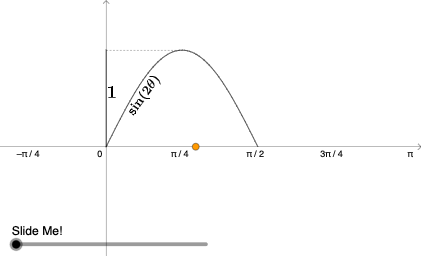
This example demonstrates the proof of the double angle trigonometric identity using the method of equal areas. Core mathematical concepts include trigonometric functions, area calculations, and geometric transformations. GeoGebra commands and objects like segments, vectors, rotations, and polygons are utilized in the construction. Suitable for high school mathematics teaching and geometric proof learning.
GeoGebra Commands & Parameters
Segment((0, 0), (0, 1)) → iDilate(A, If[0 < b ≤ 1, 1 - b, 0], B) → A'Segment(A, A') → jDilate(A, If[3 < b ≤ 4, 4 - b, 0], E) → A'_{1}Vector(A, A'_{1}) → uLine(A, E) → kTranslate(A, u) → A'_{2}Translate(A', u) → A''Segment(A'_{2}, A'') → j'Rotate(A'_{2}, If[3 < b ≤ 4, ((b - 3) * pi / 2), pi / 2], A'_{2}) → FRotate(A'', If[3 < b ≤ 4, ((b - 3) * pi / 2), pi / 2], A'_{2}) → A'''Segment(F, A''') → j''Dilate(A''', If[4 < b ≤ 5, 5 - b, 0], G) → HVector(A''', H) → vTranslate(F, v) → F'Translate(A''', v) → ISegment(F', I) → j'''Dilate(E, If[5 < b ≤ 6, 6 - b, 0], A''') → E'Vector(E, E') → wTranslate(i, w) → i'Segment((0, 0), A) → lDilate(A, If[8 < b ≤ 9, 9 - b, 0], C) → A'_{3}Segment(A, A'_{3}) → mRotate(A, If[10 < b ≤ 11, ((-(b - 10)) * pi / 2), ((-pi)) / 2], A) → A'_{4}Rotate(A'_{3}, If[10 < b ≤ 11, ((-(b - 10)) * pi / 2), ((-pi)) / 2], A) → JSegment(A'_{4}, J) → m'Rotate(A'_{4}, If[11 < b ≤ 12, ((-(b - 11)) * pi), (-pi)], J) → KRotate(J, If[11 < b ≤ 12, ((-(b - 11)) * pi), (-pi)], J) → J'Segment(K, J') → m''Dilate(A, If[14 < b ≤ 15, 15 - b, 0], D) → A'_{5}Segment(A, A'_{5}) → nRotate(A, If[16 < b ≤ 17, ((b - 16) * pi), pi], A) → A'_{6}Rotate(A'_{5}, If[16 < b ≤ 17, ((b - 16) * pi), pi], A) → LSegment(A'_{6}, L) → n'Dilate(A, If[17 < b ≤ 18, 18 - b, 0], K) → A'_{7}Vector(A, A'_{7}) → cTranslate(A'_{6}, c) → MTranslate(L, c) → L'Segment(M, L') → n''Polygon(G, N, E, E') → q1, g_1, n_1, e, e'Polygon(A, K, L', L) → q2, a_1, k_1, l', l_1Dilate(A, If[18 < b ≤ 19, 19 - b, 0], L) → A'_{8}Vector(A, A'_{8}) → dTranslate(A'_{4}, d) → OTranslate(J, d) → J'_{1}Segment(O, J'_{1}) → m''_{1}Translate(K, d) → K'Translate(J', d) → J''Segment(K', J'') → m'''Circle(N, m' + m'') → sRay(E, Mirror[E', yAxis]) → f_1Intersect(s, f_1) → P,Dilate(E, If[20 < b ≤ 21, 21 - b, 0], P) → E'_{1}Vector(E, E'_{1}) → tTranslate(E, t) → E'_{2}Translate(E', t) → E''Polygon(G, E'', E'_{1}, N) → q3, g_2, e'', e'_{1}, n_2Line(G, E'') → rLine(N, P) → h_1OrthogonalLine(G, h_1) → i_1Intersect(h_1, i_1) → QDilate(N, If[22 < b ≤ 23, 23 - b, 0], Q) → N'Vector(N, N') → u_1Translate(E'_{2}, u_1) → RPolygon(E'', G, N', R) → q4, j_1, g_3, m_1, r_1Dilate(Q, If[24 < b ≤ 25, 25 - b, 0], L) → Q'Vector(Q, Q') → v_1Translate(E'', v_1) → E'''Translate(G, v_1) → G'Translate(N', v_1) → N''Translate(R, v_1) → R'Polygon(E''', G', N'', R') → q4', e''', g', p_1, r'Line(L, r) → q_1Point(q_1) → SAngle(L', L, S) → αRotate(E''', If[24 < b ≤ 25, ((-(b - 24)) * α), (-α)], N'') → TRotate(G', If[24 < b ≤ 25, ((-(b - 24)) * α), (-α)], N'') → G''Rotate(N'', If[24 < b ≤ 25, ((-(b - 24)) * α), (-α)], N'') → N'''Rotate(R', If[24 < b ≤ 25, ((-(b - 24)) * α), (-α)], N'') → R''Polygon(T, G'', N''', R'') → q4'', t_1, g'', n''', r''Intersect(f, q, (0.5235987757682062, 0.866025403954346)) → URotateText(text1, pi / 3 - 0.1) → text2RotateText(text3, pi / 4) → text4RotateText(text5, ((-pi)) / 10) → text6RotateText(text8, pi / 2) → text9Segment((0, 1), (pi / 4, 1)) → f_4
AI Drawing Prompt Reference
A geometric proof diagram illustrating the double-angle trigonometric identity sin(2θ) = 2 sinθ cosθ using the method of equal areas. The diagram includes a triangle and a rotated triangle, showing that their areas are equal, leading to the identity. It also features line segments, vectors, and scaling transformations. The overall figure is static and educational, presenting the geometric relationship through area equality.
The prompt above was compiled from the original drawing commands and is for reference only.