
Geometric Construction of the Tangent Function Graph
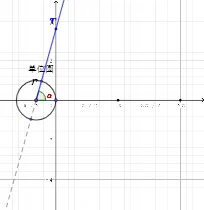
This example demonstrates, via geometric construction, the characteristic behavior of the tangent function: its periodicity and the vertical asymptotes occurring at π/2 + kπ. The main mathematical ideas include y = tan(x), the fundamental period π, and the correspondence between angles and function values (often linked to unit-circle angle interpretation). The construction workflow is to define parameterized points using rays and angles, then employ intersections and symmetry operations (e.g., rotations and mirror-based extensions) to generate repeated and correctly oriented branches of the graph. In GeoGebra, commands such as Rotate, Ray, Intersect, Circle, Angle, Segment, CircleArc, and Mirror are used to map angles to rays/circle arcs and to extend the structure across periods; objects like f, g, h support expressing the functional/relational components, while text and equations (eq2, eq3) annotate key statements. Suitable for upper secondary and early university learners, for teaching function graphing, exploring periodic behavior, and building geometric intuition for why tan(x) grows without bound near its asymptotes.
Loading the math board and drawing, please wait…