
Real Number Sets Demo
Loading the math board and drawing, please wait…
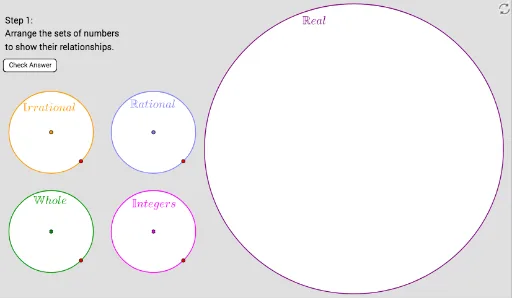
This example demonstrates the geometric representation of real number sets, including rational, irrational, and complex numbers in the coordinate system. It involves core math concepts like real number classification, coordinate geometry, and visual representation of sets. Construction uses commands like Point, Circle, Corner, Polygon with parameters such as dimensions, r1, c1 to create sets W, Z, Q, R, C. Suitable for middle school and above mathematics education to visually understand the structure and properties of real number sets.
GeoGebra Commands & Parameters
Point(Line[W_c, y = (-x)]) → W_rCircle(W_c, W_r) → WPoint(Line[Z_c, y = (-x)]) → Z_rCircle(Z_c, Z_r) → ZPoint(Line[Q_c, y = (-x)]) → Q_rCircle(Q_c, Q_r) → QPoint(Line[R_c, y = (-x)]) → R_rCircle(R_c, R_r) → RPoint(Line[C_c, y = (-x)]) → C_rCircle(C_c, C_r) → CCorner(5) → APolygon(Corner[1], Corner[2], Corner[3], Corner[4]) → blankout, a, b, c, dCircle(R_c, R_r) → eCircle(C_c, C_r) → fCircle(Q_c, Q_r) → gCircle(W_c, W_r) → hCircle(Z_c, Z_r) → k
AI Drawing Prompt Reference
In a coordinate system, draw circles to represent the sets of rational, integer, real, and complex numbers. Each set is defined by a line and a point on it, symmetric to the origin. The circle for real numbers contains the one for integers, which contains the one for rationals, which contains all points. The outermost circle represents the complex number set. Connect the centers of the five circles with a pentagon to form a closed shape.
The prompt above was compiled from the original drawing commands and is for reference only.