
Area of a Kite by Edward Knote
Loading the math board and drawing, please wait…
In collections
Area Formulas
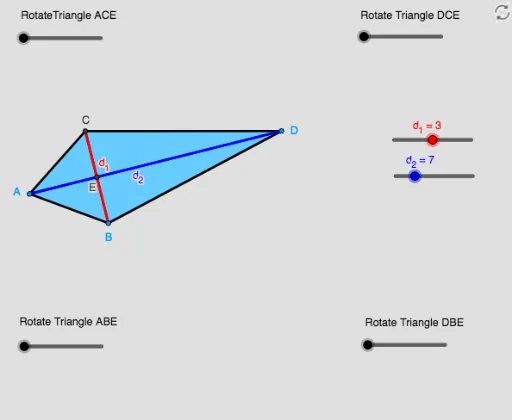
This example demonstrates how to calculate the area of a kite using geometric construction. Key mathematical concepts include geometric construction, polygons, and area calculation. It uses commands such as point, segment, circle, intersection, polygon, midpoint, mirror, and rotate in GeoGebra. Suitable for middle school and above students or teachers to understand the properties of geometric shapes and area calculation methods.
GeoGebra Commands & Parameters
Point(Circle[A, d_1]) → BSegment(A, B) → b_3Circle(A, B) → cPoint(Circle[B, d_2]) → DSegment(B, D) → fCircle(D, B) → gIntersect(c, g, 1) → CSegment(A, C) → dSegment(C, D) → hSegment(A, D) → d_5Segment(B, C) → d_6Intersect(d_5, d_6) → E_1Polygon(C, E_1, D) → P, d_4, c_1, e_1Polygon(E_1, B, D) → Q, d_7, e_2, b_1Polygon(E_1, C, A) → R, a_1, e_3, c_2Polygon(E_1, B, A) → S, a_2, e_4, b_2Midpoint(C, D) → FMirror(C, F) → C'Mirror(E_1, F) → E'Mirror(D, F) → D'Midpoint(A, C) → GMidpoint(A, B) → HMidpoint(B, D) → IMirror(E_1, G) → E'_1Mirror(C, G) → C'_1Mirror(A, G) → A'Mirror(E_1, H) → E'_2Mirror(B, H) → B'Mirror(A, H) → A'_1Mirror(E_1, I) → E'_3Mirror(B, I) → B'_1Mirror(D, I) → D'_1Midpoint(B, C) → ERotate(E_1, α, G) → E_1'Rotate(C, α, G) → C'_2Rotate(A, α, G) → A'_2Polygon(E_1', C'_2, A'_2) → R', a'_2, e_1', c'_2Rotate(C, (-β), F) → C'_4Rotate(E_1, (-β), F) → E_3Rotate(D, (-β), F) → D'_3Polygon(C'_4, E_3, D'_3) → P', d'_3, c'_4, e_5Rotate(E_1, γ, H) → E_2Rotate(B, γ, H) → B'_2Rotate(A, γ, H) → A'_3Polygon(E_2, B'_2, A'_3) → S', a'_3, e_6, b'_2Rotate(E_1, (-δ), I) → E_4Rotate(B, (-δ), I) → B'_3Rotate(D, (-δ), I) → D'_2Polygon(E_4, B'_3, D'_2) → Q', d'_2, e_7, b'_3