
Reactions of Three-Supported Beam to Oblique Force
Loading the math board and drawing, please wait…
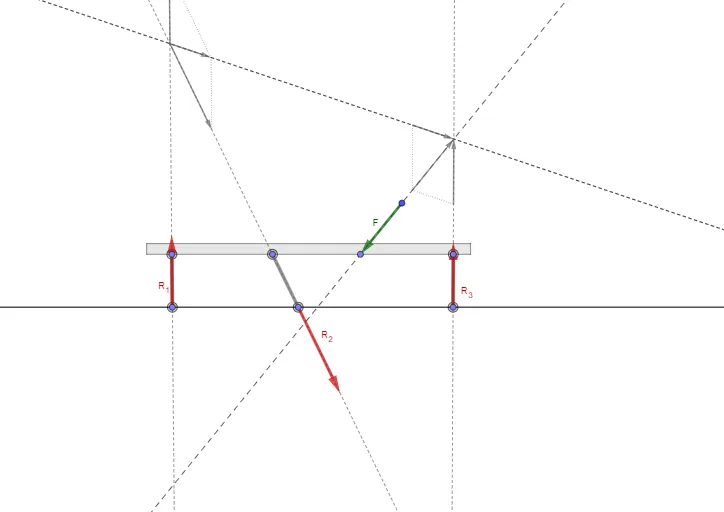
This example demonstrates the reactions of a three-supported beam under an oblique force. Key mathematical concepts include trigonometry and coordinate geometry. Using GeoGebra commands such as Line, Point, OrthogonalLine, and Intersect, the force analysis model of the beam is constructed. Suitable for high school physics and mathematics education to help students understand the decomposition and synthesis of forces.
GeoGebra Commands & Parameters
Line(A, xAxis) → fLine(B, f) → gPoint(f) → COrthogonalLine(C, f) → hPoint(g) → DOrthogonalLine(D, f) → iIntersect(f, i) → EIntersect(g, h) → F_1Polygon(C, E, D, F_1) → c1, c, e, d, f_1Rotate(D, 30°, D) → D'Point(d) → VVector(W, V) → FLine(V, W) → h_1Line(G, xAxis) → jPoint(d) → HPoint(j) → ISegment(H, I) → kPoint(d) → JPoint(j) → KSegment(J, K) → lPoint(d) → LPoint(j) → MSegment(L, M) → mLine(I, H) → nLine(K, J) → aLine(M, L) → bIntersect(n, a) → NIntersect(h_1, b) → OLine(N, O) → g_1Translate(O, F) → O'Line(O', g_1) → i_1Line(O', b) → j_1Intersect(j_1, g_1) → PSegment(O', P) → k_1Intersect(b, i_1) → QSegment(O', Q) → l_1Vector(P, O) → vVector(Q, O) → wTranslate(N, v) → N'Vector(N, N') → a_1Line(N', a) → m_1Line(N', n) → n_1Intersect(n, m_1) → RVector(N, R) → b_1Intersect(a, n_1) → SVector(N, S) → d_1Segment(R, N') → p_1Segment(N', S) → q_1Translate(M, w) → M'Vector(M, M') → R_3Translate(I, b_1) → I'Vector(I, I') → R_1Translate(K, d_1) → K'Vector(K, K') → R_2Circle(M, 0.15) → c_1Circle(H, 0.15) → pCircle(I, 0.15) → qCircle(J, 0.15) → rCircle(K, 0.15) → sCircle(L, 0.15) → tVector(O', O) → u
AI Drawing Prompt Reference
Draw a three-supported beam subjected to an oblique force. Start by drawing the x-axis, then take points A and B on it. Draw a perpendicular line f through A and a perpendicular line g through B. On f, take point C and on g, take point D. Draw perpendicular lines h and i through C and D, respectively, with their intersections at E and F_1. Construct quadrilateral CEDF_1. Rotate point D by 30 degrees to get D', and construct vector VD. Draw line h_1 through D and D'. Construct a perpendicular line j through the x-axis, and take points H and I on it. Draw line segment HI, then take points J and K on j, draw line segment JK, and take points L and M on j, draw line segment LM. Draw lines n through H and I, a through J and K, and b through M and L, with their intersections at N and O. Draw line NO to get g_1. Translate point O to get O', and draw lines i_1 through O' to g_1, and j_1 through O' to b, with their intersection at P. Draw line segment OP, and construct vectors v and w from O to P. Draw line segments p_1 from N to N' and q_1 from N' to S.
The prompt above was compiled from the original drawing commands and is for reference only.