
Range, Domain, and Period of a Sine Function
Loading the math board and drawing, please wait…
In collections
Sine and Cosine Functions
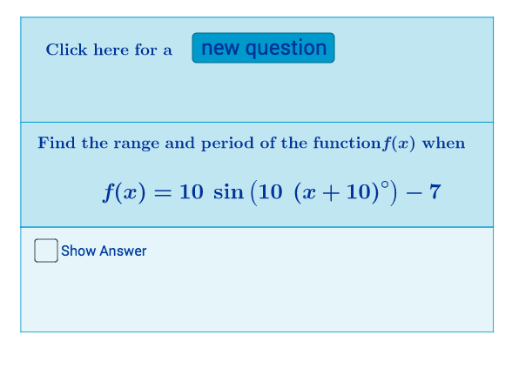
This GeoGebra example provides an interactive visualization of how the domain, range, and period of a sine function y = a·sin(bx + c) change as its parameters vary. It demonstrates the fundamental properties of trigonometric functions, including amplitude, period, and vertical shift, and how these relate to the graph's shape. The construction uses Random commands to generate initial parameters, sliders for real-time adjustment, points and segments to mark key features, polygons to highlight intervals or areas, and text objects to display computed values of domain, range, and period. Suitable for high school or introductory college students learning trigonometry, this tool supports inquiry-based exploration and helps teachers illustrate the effects of parameter changes on the sine curve.
GeoGebra Commands & Parameters
Random(1, 10) → aRandom(-10, 10) → bPolygon(A, B, C, D) → poly1, a_1, b_1, c_1, d_1Point(d_1) → EPoint(b_1) → FPolygon(D, E, F, C) → poly2, d_2, e, f_1, c_2Polygon(A, E, F, B) → poly3, a_2, e_1, f_2, b_2Point(a_2) → GPoint(f_2) → HSegment(G, H) → iRandomElement({1, 2, 3, 4, 5, 6, 8, 9, 10, 12, 15, 18, 20, 36, 60}) → pRandomElement({10, -10, 20, -20, 30, -30, 0}) → q
AI Drawing Prompt Reference
Draw a sine function graph with equation y = a·sin(bx + c), where amplitude a and frequency b are randomly generated and adjustable via sliders. Show coordinate axes and grid, with a smooth curve representing the sine wave. Label the domain, range, and period values near the curve. Use colored polygons or shaded areas to highlight one full period interval, marking its endpoints with points and connecting them with a segment to emphasize the period length. Also mark key points on the curve such as maxima, minima, and zeros. The layout should be clear for observing how parameter changes affect the function's shape.
The prompt above was compiled from the original drawing commands and is for reference only.