
Vibrating String: Periodic Motion with Piecewise Polygons
Loading the math board and drawing, please wait…
In collections
geometriadinamica.es
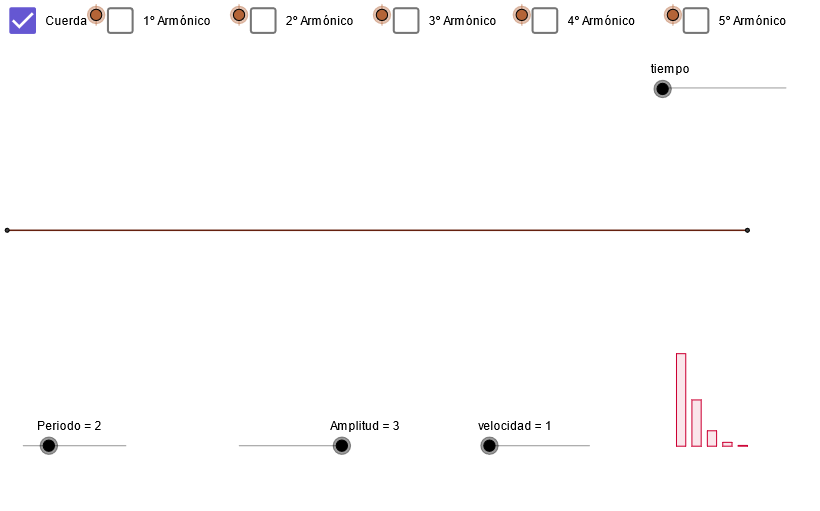
This example demonstrates a vibrating string’s periodic motion by modeling how a point’s position changes over time using parameters such as amplitude and period. It highlights how the wave-like shape can be constructed visually by assembling multiple line segments into piecewise polygons, showing a “stitched” approximation of the oscillation. Key math concepts include functions (position as a function of time), the periodicity typical of sinusoidal/trigonometric vibration, and parameterized modeling with amplitude, period, and velocity. Construction-wise, the GeoGebra command summary indicates the use of Function and Polygon. The objects include parameters p and L, Amplitud (amplitude), Periodo (period), velocidad (velocity), and time t, together with derived coefficients A1,a1,...,A5,a5 and vertices Q, P, verC, ver1–ver5. These vertices are then connected via poly1 and poly2 to form the composed shapes that represent the vibrating string waveform. Suitable for middle school to early university use in function modeling, trigonometry/periodic behavior, and interactive graphing with GeoGebra.
GeoGebra Commands & Parameters
Function((((A1 * Amplitud) * sin((p * (x / L + 1 / 2)))) * sin((((2 * p) * t) * velocidad / Periodo))), ((-L)) / 2, L / 2) → a1Function(((((-A2) * Amplitud / 2) * sin(((2 * p) * (x / L + 1)))) * sin((((4 * p) * t) * velocidad / Periodo))), ((-L)) / 2, L / 2) → a2Function((((A3^(2) * Amplitud / 6) * sin(((3 * p) * (x / L + 3 / 2)))) * sin((((6 * p) * t) * velocidad / Periodo))), ((-L)) / 2, L / 2) → a3Function(((((-A4^(4)) * Amplitud / 24) * sin(((4 * p) * (x / L + 2)))) * sin((((8 * p) * t) * velocidad / Periodo))), ((-L)) / 2, L / 2) → a4Function((((A5^(6) * Amplitud / 120) * sin(((5 * p) * (x / L + 5 / 2)))) * sin((((10 * p) * t) * velocidad / Periodo))), ((-L)) / 2, L / 2) → a5Function(a1(x) + a2(x) + a3(x) + a4(x) + a5(x), ((-L)) / 2, L / 2) → cPolygon(P1a, P1b, P1c, P1d) → poly1, p1c, p1b, p1a, p1dPolygon(P2a, P2b, P2c, P2d) → poly2, p2a, p2b, p2c, p2dPolygon(P3a, P3b, P3c, P3d) → poly3, p3a, p3b, p3c, p3dPolygon(P4a, P4b, P4c, P4d) → poly4, p4a, p4b, p4c, p4dPolygon(P5a, P5b, P5c, P5d) → poly5, p5a, p5b, p5c, p5d
AI Drawing Prompt Reference
Draw a vibrating string by assembling multiple line segments into piecewise polygons to illustrate the periodic motion. Use parameters like amplitude, period, and velocity to define the string's shape and movement. First, define the functions for each segment, then sum these functions to get the overall string shape. Next, use the function values as vertex coordinates to construct multiple piecewise polygons representing the string's waveform.
The prompt above was compiled from the original drawing commands and is for reference only.