
Radius of Convergence of Complex Power Series
Loading the math board and drawing, please wait…
In collections
Complex numbers
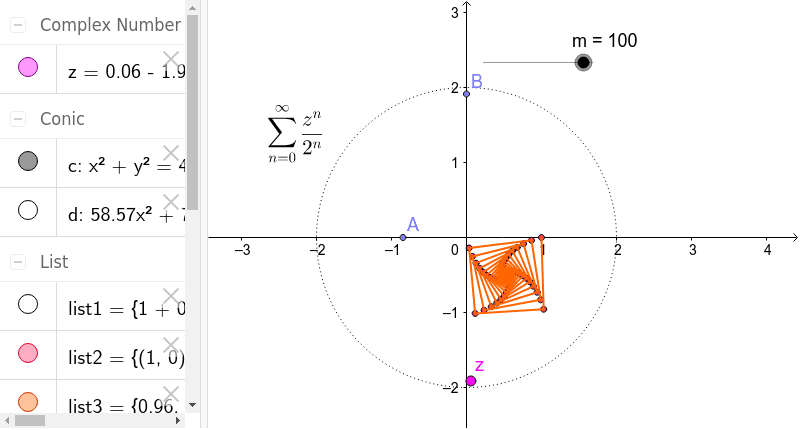
① This example demonstrates the convergence disk of radius 2 for the complex power series ∑ z^n/2^n. ② Core concepts include complex numbers, power series, radius of convergence, and the root/ratio test (limits). ③ Construction highlights: Circle draws the convergence circle; Point marks the center and boundary points; Mirror and Ellipse provide symmetric visual aids; Sequence creates the term‑point lists list1, list2, list3; text1 labels the radius. ④ Suitable for university calculus/complex analysis lectures and for advanced high‑school math contest enrichment.
GeoGebra Commands & Parameters
Circle((0, 0), 2) → cPoint(xAxis) → AMirror(A, yAxis) → A'Point(yAxis) → BEllipse(A, A', B) → dPoint(d) → zSequence(z^(n) / 2^(n), n, 0, 100) → list1Sequence(Sum[list1, n], n, 1, m) → list2Sequence(Segment[Element[list2, i], Element[list2, i + 1]], i, 1, m - 1) → list3
AI Drawing Prompt Reference
Draw a circle centered at the origin with radius 2 to represent the convergence disk of the complex power series ∑ z^n/2^n. Mark points on the x-axis and y-axis, and use them to construct an ellipse for symmetric visual aid. Generate a sequence of points for the power series and connect them with line segments to show the trajectory of partial sums. Label the radius of the circle and highlight key concepts like complex numbers, power series, and radius of convergence.
The prompt above was compiled from the original drawing commands and is for reference only.