
Quadratic Functions in Vertex Form
Loading the math board and drawing, please wait…
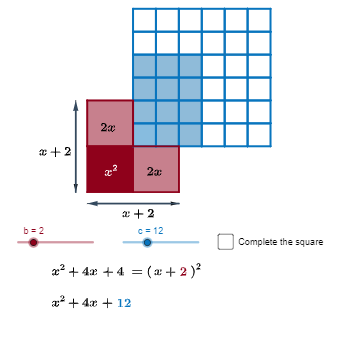
This example demonstrates quadratic functions in vertex form. Key mathematical concepts include the properties and transformations of quadratic functions. Using GeoGebra commands such as Polygon, Intersect, Vector, Midpoint, Translate, and Segment, the example dynamically shows the transformations of quadratic functions. Suitable for high school mathematics education and learning.
GeoGebra Commands & Parameters
Polygon(B, D, C, A) → poly1, b_1, d, c_2, b_7Polygon(D, F, E, C) → poly2, d_1, f, f_5, c_1Polygon(G, I, D, B) → poly3, g, i, d_2, b_2Polygon(J, T, A_1, D) → p1, j, t_5, b_8, d_3Polygon(B_1, Q, T, J) → p2, b_3, q, t_1, j_1Polygon(K, P, Q, B_1) → p5, k, q_6, q_1, b_4Polygon(Z_1, W_1, M, L) → p17, z_1, w_1, m_1, l_1Polygon(A_2, B_2, W_1, Z_1) → p26, b_9, b_5, w_2, z_2Polygon(Q, R, S, T) → p4, q_2, r, s, t_2Polygon(T, S, J_2, A_1) → p3, t_3, s_1, j_2, c_7Polygon(P, O, R, Q) → p6, q_8, o, r_1, q_3Polygon(S, U, K_2, J_2) → p7, s_2, u, k_2, j_3Polygon(R, V, U, S) → p8, r_2, v, u_1, s_3Polygon(O, W, V, R) → p9, o_1, w, v_1, r_3Polygon(L, M, P, K) → p10, l_2, m_2, q_9, k_3Polygon(M, N, O, P) → p11, m_3, n, o_2, q_{10}Polygon(N, Z, W, O) → p12, n_1, z, w_3, o_3Polygon(Z, K_1, J_1, W) → p16, z_3, k_4, j_4, w_4Polygon(W, J_1, I_1, V) → p15, w_5, j_5, i_1, v_2Polygon(V, I_1, H_1, U) → p14, v_3, i_2, h_1, u_2Polygon(U, H_1, C_1, K_2) → p13, u_3, h_2, c_3, k_5Polygon(W_1, V_1, N, M) → p18, w_6, v_4, n_2, mPolygon(V_1, U_1, Z, N) → p19, v_5, u_4, z_4, n_3Polygon(H_1, G_1, D_1, C_1) → p21, h_3, g_1, d_4, c_4Polygon(I_1, N_1, G_1, H_1) → p22, i_3, n_4, g_2, h_4Polygon(J_1, M_1, N_1, I_1) → p23, j_6, m_4, n_5, i_4Polygon(K_1, L_1, M_1, J_1) → p24, k_6, l_3, m_5, j_7Polygon(T_1, S_1, L_1, K_1) → p25, t_9, s_4, l_4, k_7Polygon(B_2, C_2, V_1, W_1) → p27, b_6, c_5, v_6, w_7Polygon(C_2, D_2, U_1, V_1) → p28, c_6, d_5, u_6, v_7Polygon(D_2, E_2, T_1, U_1) → p29, d_6, f_7, t_6, u_7Polygon(E_2, F_2, S_1, T_1) → p30, f_6, f_2, s_5, t_7Polygon(G_1, F_1, E_1, D_1) → p31, g_3, f_1, f_8, d_7Polygon(N_1, O_1, F_1, G_1) → p32, n_6, o_4, f_3, g_4Polygon(M_1, P_1, O_1, N_1) → p33, m_6, q_7, o_5, n_7Polygon(L_1, Q_1, P_1, M_1) → p34, l_5, q_4, p_5, m_7Polygon(S_1, R_1, Q_1, L_1) → p35, s_6, r_4, q_5, l_6Polygon(F_2, G_2, R_1, S_1) → p36, f_4, g_5, r_5, s_7Intersect(b_7, c_2) → HIntersect(b_2, g) → H_2Intersect(g_5, f_4) → L_2Intersect(f_5, f) → M_2Vector(U_2, V_2) → lMidpoint(U_2, V_2) → W_2Midpoint(A_3, Z_2) → B_3Vector((0, 0), (0, -0.2)) → f_9Translate(W_2, f_9) → C_3Polygon(T_1, U_1, Z, K_1) → p20, t_8, u_5, z_5, k_8Segment(K_1, L_1) → pSegment(T_1, K_1) → z_{6}Vector(A_3, Z_2) → aVector(Z_2, A_3) → eVector(V_2, U_2) → a_1Segment(F, N_2) → p_6Segment(S_1, L_1) → hSegment(F, A_{100}) → p_1Segment(I, A_{100}) → k_1
AI Drawing Prompt Reference
Draw a graph demonstrating quadratic functions in vertex form, including multiple polygons and their intersections, showing transformations through vectors, midpoints, and translations. Start by sketching the base polygons, then calculate their intersections, use vectors and midpoints to determine key positions, and finally apply translations to illustrate the transformations of quadratic functions, presenting the geometric properties and transformation relationships of quadratic functions overall.
The prompt above was compiled from the original drawing commands and is for reference only.