
Quiz: Graphing Cubic Functions with Transformations
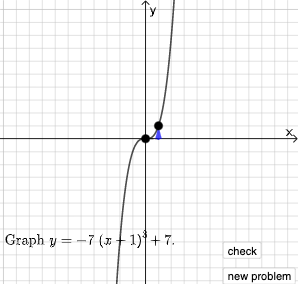
Loading the math board and drawing, please wait…
This interactive quiz demonstrates how cubic functions change under transformations such as translation, scaling, and reflection. It focuses on the general form of cubic functions, horizontal and vertical shifts, stretches/compressions, and symmetry about axes. The construction uses GeoGebra commands including Point, Line, Vector, Polygon, Segment, RandomElement, Random, If, and RotateText to generate random parameters, build reference grids, and provide dynamic feedback. Sliders allow real-time adjustment of transformation parameters, making the graph update instantly. Suitable for high school or introductory college students learning function transformations, and useful for classroom demonstrations or self-paced practice.
GeoGebra Commands & Parameters
Point(Segment[(h + 1, y(C) + 10), (h + 1, y(C) - 10)]) → DLine(A, B) → fVector(A, C) → uPolygon(A, C, B) → t1, b, a_1, cRotateText(text2, pi / 2) → text3Segment(A, C) → h_{1}Vector(C, D) → vVector((h, 0), A) → wVector((0, 0), (h, 0)) → jRandomElement({-8, -7, -6, -5, -4, -3, -2, -1, 1, 2, 3, 4, 5, 6, 7, 8}) → nRandom(-8, 8) → oRandom(-8, 8) → pIf(h ≟ o, "Horizontal shift is correct!", "Horizontal shift is not correct.") → text9If(n ≟ rise, "Vertical stretch is correct!", "Vertical stretch is not correct.") → text10If(p ≟ y(A), "Vertical shift is correct!", "Vertical shift is not correct.") → text11
AI Drawing Prompt Reference
Create a coordinate-plane visualization for practicing transformations of cubic functions. Include a reference line determined by two points, and place key base points (A and C) with the segment joining A and C as a main reference. From point A, draw the vector pointing toward C, then use these relationships to form a polygon that highlights the geometric structure behind horizontal/vertical shifts and stretches/compressions. Add an additional vector starting at C pointing to another constructed point, and include a horizontal-displacement vector to represent the horizontal shift. Reserve space for rotated text feedback, and display messages corresponding to checks of the horizontal shift, vertical stretch, and vertical shift, with text rotated to an appropriate orientation.
The prompt above was compiled from the original drawing commands and is for reference only.