
Pythagorean Theorem (Special Case) Dynamic Demonstration
Loading the math board and drawing, please wait…
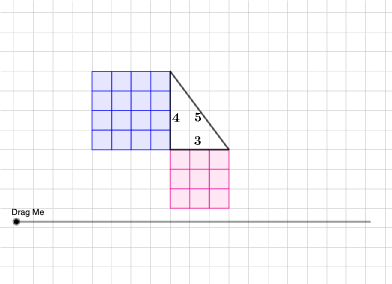
① This GeoGebra example dynamically demonstrates a special case of the Pythagorean theorem, where the two legs of a right triangle are equal, visually verifying that the square on the hypotenuse equals the sum of the squares on the other two sides. ② The core mathematical concept is the Pythagorean theorem, involving right triangles, areas of squares, rotations and translations, and the construction of auxiliary lines to prove area equality. ③ Construction highlights: Based on the construction summary, commands such as Point, Segment, Polygon, Rotate, Ray, Circle, Intersect, Vector, Translate, Midpoint, OrthogonalLine, LineBisector, and Line are used. Multiple points (A, B, C, etc.), segments (a, b, c), polygons (q1, q2), and rotated images (A', B', etc.) are created to form squares on each side and demonstrate the area relationship through rotation. ④ Suitable for middle school geometry teaching, helping students grasp the geometric meaning of the Pythagorean theorem, and useful for classroom demonstrations or self-exploration by adjusting the triangle shape to observe area changes.
GeoGebra Commands & Parameters
Point(yAxis) → APoint(yAxis) → BPoint(xAxis) → CSegment(B, C) → gSegment(C, A) → hPoint(xAxis) → GPolygon(H, G, B, A) → q1, h_1, g_1, b, aRotate(H, 0.6435, A) → H'_{1}Rotate(G, 0.6435, A) → G'_{1}Rotate(B, 0.6435, A) → B'_{2}Rotate(A, 0.6435, A) → A'_{2}Rotate(H, c, A) → H'Rotate(G, c, A) → G'Rotate(B, c, A) → B'Rotate(A, c, A) → A'Polygon(H', G', B', A') → q1', h', g', b', a'Ray(G'_{1}, B'_{2}) → iPolygon(H'_{1}, G'_{1}, B'_{2}, A) → q2, h'_{1}, g'_{1}, b'_{2}, a_1Circle(G'_{1}, c - 0.64) → dIntersect(d, i) → D,Vector(G'_{1}, D) → uTranslate(H'_{1}, u) → ETranslate(G'_{1}, u) → FTranslate(B'_{2}, u) → ITranslate(A, u) → A'_{1}Polygon(E, F, I, A'_{1}) → q2', e, f_1, i_1, a'_{1}Segment(H', G') → fSegment(G', B') → jSegment(B', A) → kSegment(A, H') → mMidpoint(H', A) → JMidpoint(G', B') → KMidpoint(H', J) → LMidpoint(G', K) → MMidpoint(K, B') → NMidpoint(J, A) → OMidpoint(H', G') → QMidpoint(H', Q) → PMidpoint(Q, G') → RMidpoint(A, B') → SMidpoint(A, S) → TMidpoint(S, B') → USegment(L, M) → lSegment(J, K) → nSegment(O, N) → pSegment(P, T) → qSegment(Q, S) → rSegment(R, U) → sMidpoint(A'_{1}, E) → VMidpoint(I, D) → WMidpoint(V, E) → ZMidpoint(A'_{1}, V) → A_1Midpoint(I, W) → B_1Midpoint(W, D) → C_1Segment(Z, C_1) → tSegment(V, W) → j_1Segment(A_1, B_1) → k_1Midpoint(E, D) → D_1Midpoint(D_1, D) → E_1Midpoint(E, D_1) → F_1Midpoint(A'_{1}, I) → G_1Midpoint(A'_{1}, G_1) → H_1Midpoint(G_1, I) → I_1Segment(F_1, H_1) → l_1Segment(D_1, G_1) → m_1Segment(E_1, I_1) → n_1Point(yAxis) → J_1Polygon(B, M_1, L_1, C) → q3, b_1, p_1, q_1, c_1Intersect(i, h) → O_1OrthogonalLine(N_1, i) → r_1Intersect(r_1, i) → P_1Circle(P_1, 1) → d_1Intersect(d_1, r_1, 2) → Q_1LineBisector(N_1, Q_1) → s_1LineBisector(C, B) → t_1Intersect(s_1, t_1) → R_1Rotate(B, c - 4.64, R_1) → B'_{1}Rotate(M_1, c - 4.64, R_1) → S_1Rotate(L_1, c - 4.64, R_1) → T_1Rotate(C, c - 4.64, R_1) → C'Polygon(B'_{1}, S_1, T_1, C') → q3', b'_{1}, e_1, f_2, c'Polygon(M_1, W_1, Z_1, L_1) → q4, h_2, w_1, z_1, i_2Intersect(d_1, i, 1) → A_2Midpoint(O_1, A_2) → B_2Midpoint(M_1, L_1) → C_2Segment(A_2, L_1) → j_2Rotate(M_1, c - 6.85, M_1) → E_2Rotate(W_1, c - 6.85, M_1) → F_2Rotate(Z_1, c - 6.85, M_1) → G_2Rotate(L_1, c - 6.85, M_1) → H_2Polygon(E_2, F_2, G_2, H_2) → q4', e_2, k_2, l_2, m_2OrthogonalLine(M_1, u) → n_2OrthogonalLine(C, n_2) → p_2Intersect(n_2, p_2) → I_2Polygon(M_1, I_2, C, O_1) → q5, q_2, r_2, c_2, o_1Circle(I_2, c - 7.49) → d_2Intersect(d_2, p_2) → J_2, K_2Vector(I_2, J_2) → vTranslate(M_1, v) → L_2Translate(I_2, v) → M_2Translate(C, v) → C'_{1}Translate(O_1, v) → N_2Polygon(L_2, M_2, C'_{1}, N_2) → q5', s_2, t_2, c'_{1}, a_2Polygon(A, O_1, P_1, N_1) → q6, a_3, b_2, f_3, g_3Midpoint(N_1, A) → O_2Midpoint(N_1, O_2) → P_2Midpoint(O_2, A) → Q_2Midpoint(P_1, O_1) → R_2Midpoint(O_1, R_2) → S_2Midpoint(N_1, P_1) → T_2Midpoint(N_1, T_2) → U_2Midpoint(T_2, A) → V_2Midpoint(O_1, A) → W_2Midpoint(A, W_2) → Z_2Segment(Q_2, S_2) → h_3Segment(O_2, R_2) → i_3Segment(P_2, A_2) → j_3Segment(U_2, Z_2) → k_3Segment(W_2, T_2) → l_3Midpoint(W_2, O_1) → A_3Segment(Q_1, A_3) → m_3Intersect(d_1, i) → B_3, C_3OrthogonalLine(C_3, i) → n_3OrthogonalLine(N_1, r_1) → p_3Intersect(n_3, p_3) → D_3Circle(D_3, 1) → c_3Intersect(c_3, n_3, 1) → E_3Circle(E_3, 1) → d_3Intersect(d_3, n_3, 1) → F_3Circle(F_3, 1) → e_3Intersect(e_3, n_3, 1) → G_3Circle(N_1, 1) → q_3Intersect(d_3, q_3, 1) → H_3Circle(H_3, 1) → r_3Intersect(e_3, r_3, 1) → I_3Polygon(N_1, Q_1, G_3, D_3) → q7, s_3, t_3, b_3, f_4Segment(E_3, H_3) → g_4Segment(F_3, I_3) → h_4Segment(C', B'_{1}) → i_4Segment(B'_{1}, S_1) → j_4Segment(S_1, T_1) → k_4Segment(T_1, C') → l_4Circle(C', 1) → c_4Circle(T_1, 1) → d_4Intersect(c_4, i_4, 1) → J_3Intersect(d_4, k_4, 1) → K_3Circle(S_1, 1) → e_4Intersect(e_4, k_4, 1) → L_3Circle(B'_{1}, 1) → p_4Intersect(p_4, i_4) → M_3,Segment(M_3, L_3) → m_4Segment(J_3, K_3) → n_4Circle(C'_{1}, 1) → q_4Intersect(q_4, t_2, 1) → N_3Circle(N_2, 1) → r_4Intersect(a_2, b_2) → O_3Intersect(r_4, a_2) → P_3,Segment(P_3, N_3) → s_4Circle(J_2, 1) → t_4Circle(L_2, 1) → c_5Intersect(t_4, t_2, 1) → Q_3Intersect(a_2, b_2) → R_3Intersect(c_5, a_2) → S_3,Segment(S_3, Q_3) → a_4Polygon(W_1, J_1, T_3, V_3) → q8, b_4, f_5, g_5, v_3Circle(C_3, 1) → d_5Intersect(d_5, n_3) → Z_3, A_4Segment(V_3, L_1) → h_5Polygon(G_4, L_1, K_1, T_3, V_3, W_3) → poly1, m_5, n_5, p_5, q_5, r_5, w_3Segment(W_3, P_1) → s_5Circle(W_3, c - 12.73) → t_5Intersect(t_5, s_5, 1) → B_4Vector(W_3, B_4) → wTranslate(G_4, w) → C_4Translate(L_1, w) → D_4Translate(K_1, w) → E_4Translate(T_3, w) → F_4Translate(V_3, w) → H_4Translate(W_3, w) → I_4Polygon(C_4, D_4, E_4, F_4, H_4, I_4) → poly1', i_5, j_5, k_5, l_5, a_5, b_5Circle(P_1, sqrt(2)) → g_2Line(W_3, K_1) → e_5Vector(W_3, P_1) → u_1Translate(G_4, u_1) → U_1Translate(L_1, u_1) → V_1Translate(K_1, u_1) → J_4Translate(T_3, u_1) → K_4Translate(V_3, u_1) → L_4Translate(W_3, u_1) → M_4Polygon(U_1, V_1, J_4, K_4, L_4, M_4) → poly1'_{1}, f_6, v_1, g_6, h_6, i_6, j_6Rotate(U_1, c - 19.05, P_1) → N_4Rotate(V_1, c - 19.05, P_1) → O_4Rotate(J_4, c - 19.05, P_1) → P_4Rotate(K_4, c - 19.05, P_1) → Q_4Rotate(L_4, c - 19.05, P_1) → R_4Rotate(M_4, c - 19.05, P_1) → S_4Polygon(N_4, O_4, P_4, Q_4, R_4, S_4) → poly2, k_6, o_4, l_6, m_6, n_6, p_6Midpoint(O_4, P_4) → T_4Segment(P_1, T_4) → q_6Midpoint(Q_4, P_4) → U_4Segment(P_1, U_4) → r_6Midpoint(D_4, E_4) → V_4Midpoint(F_4, E_4) → W_4Segment(B_4, W_4) → s_6Segment(B_4, V_4) → t_6Segment(M_1, H_2) → a_6Segment(H_2, G_2) → b_6Segment(G_2, F_2) → c_6Segment(F_2, M_1) → d_6Circle(H_2, 1) → e_6Intersect(e_6, a_6, 1) → Z_4Circle(G_2, 1) → c_7Intersect(c_7, c_6, 1) → A_5Circle(M_1, 1) → d_7Intersect(d_7, a_6, 1) → B_5Circle(F_2, 1) → e_7Intersect(e_7, c_6, 1) → C_5Segment(B_5, C_5) → f_7Segment(Z_4, A_5) → g_7Segment(W_3, U_3) → h_7Segment(W_3, Z_1) → i_7Segment(M_1, G_4) → j_7Midpoint(R_2, O_1) → D_5OrthogonalLine(C, h) → k_7OrthogonalLine(B_3, k_7) → l_7Intersect(k_7, l_7) → E_5OrthogonalLine(R_2, k_7) → m_7OrthogonalLine(D_5, k_7) → n_7Intersect(k_7, n_7) → F_5Intersect(k_7, m_7) → G_5Polygon(O_1, C, E_5, B_3) → q9, p_7, c_8, q_7, r_7Segment(D_5, F_5) → s_7Segment(R_2, G_5) → t_7Circle(V_3, c - 10.49) → d_8Intersect(d_8, h_5, 1) → D_2Vector(V_3, D_2) → u_2Translate(W_1, u_2) → H_5Translate(J_1, u_2) → I_5Translate(T_3, u_2) → J_5Translate(V_3, u_2) → K_5Polygon(H_5, I_5, J_5, K_5) → q8', a_7, b_7, f_8, g_8Polygon(V_3, T_3, K_1, Z_1) → q10, h_8, i_8, j_8, k_8Segment(H, G) → l_8Segment(G, B) → m_8Segment(B, A) → n_8Segment(H, A) → p_8Midpoint(H, A) → L_5Midpoint(A, B) → M_5Midpoint(B, G) → N_5Midpoint(H, G) → O_5Midpoint(H, O_5) → P_5Midpoint(O_5, G) → Q_5Midpoint(A, M_5) → R_5Midpoint(M_5, B) → S_5Midpoint(G, N_5) → T_5Midpoint(N_5, B) → U_5Midpoint(H, L_5) → V_5Midpoint(L_5, A) → W_5Segment(V_5, T_5) → q_8Segment(L_5, N_5) → r_8Segment(W_5, U_5) → s_8Segment(Q_5, S_5) → t_8Segment(O_5, M_5) → a_8Segment(P_5, R_5) → b_8Segment(M_1, L_1) → e_8Point(g) → Z_5Point(g) → A_6Segment(Z_5, V_3) → f_9Segment(A_6, W_3) → g_9Segment(A, B) → h_9Segment(B, C) → i_9Segment(C, A) → j_9Polygon(B_6, E_6, D_6, C_6) → q11, k_9, l_9, m_9, n_9
AI Drawing Prompt Reference
Draw a right triangle ABC with two equal legs. Construct squares q1 and q2 with A, B, and C as vertices. Rotate and translate squares q1 and q2 to align their corresponding sides, forming new squares q1' and q2'. Use auxiliary lines and midpoints to demonstrate that the area of the square on the hypotenuse equals the sum of the areas of the squares on the other two sides.
The prompt above was compiled from the original drawing commands and is for reference only.