
Wordless Proof of the Pythagorean Theorem #19: Geometric Construction via Transl
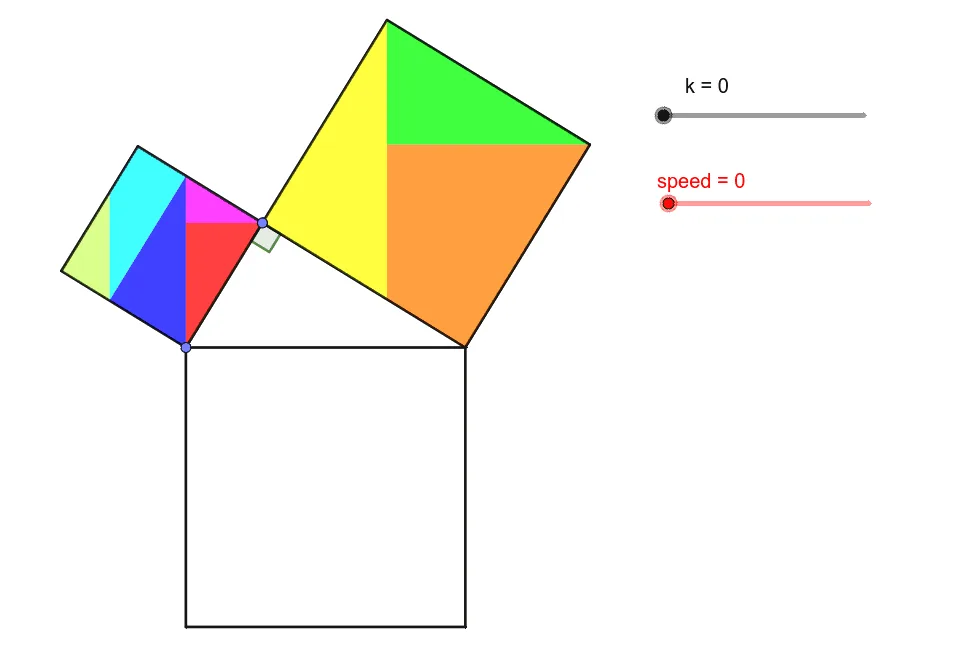
This GeoGebra example presents a visual, wordless proof of the Pythagorean theorem using geometric transformations and area equivalence. It demonstrates how squares (or related polygons) built on the sides of a right triangle can be dissected and rearranged—via translation and reflection—to show that the sum of the areas on the legs equals the area on the hypotenuse. Core mathematical concepts include the Pythagorean theorem, polygon area invariance under rigid motions, symmetry, and linear functions in coordinate geometry. The construction employs key GeoGebra commands such as Intersect, Point, Mirror, Polygon, Translate, Angle, and conditional logic (If), with objects including multiple polygons (poly1, poly2, poly3), auxiliary functions (f, g, h, etc.), sequences of points (D through P), and dynamic controls like speed and parameter t1. Ideal for middle to high school mathematics education, this interactive model supports inquiry-based learning, classroom demonstration, or enrichment activities in Euclidean geometry.
Loading the math board and drawing, please wait…