
Projective Proof of Pythagorean Theorem via Orthogonal Projection
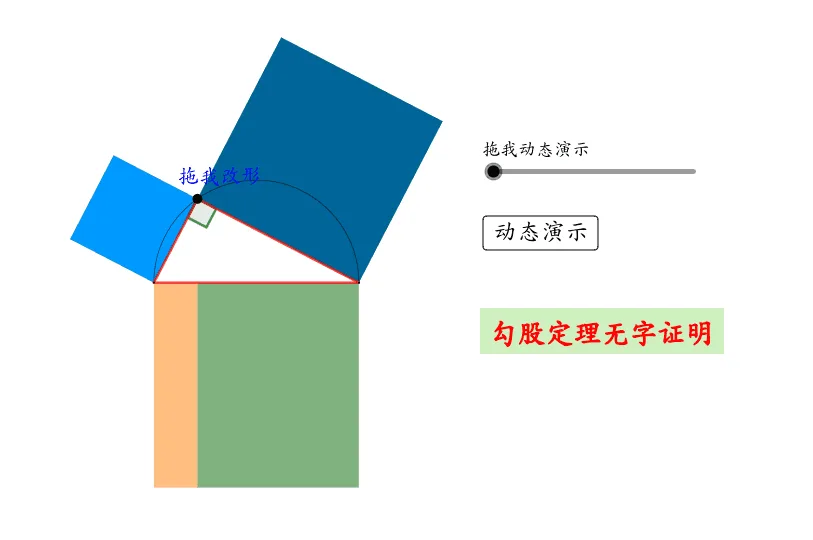
This GeoGebra example demonstrates a projective proof of the Pythagorean theorem using orthogonal projection. The core mathematical concept is that in a right triangle, the altitude to the hypotenuse creates two segments whose lengths correspond to the projections of the legs onto the hypotenuse, leading to the relation a²+b²=c² through area or similarity arguments. The construction uses a semicircle (Semicircle) to form the circumcircle, points (Point) and polygons (Polygon) to define the triangle, rotation (Rotate) and perpendicular lines (OrthogonalLine) to generate projection segments, and intersection (Intersect), conditional (If), and angle (Angle) tools to label key elements. Suitable for middle and high school geometry classes, exploring multiple proofs of the Pythagorean theorem, and dynamic math experiments that reveal the geometric essence of projection.
Loading the math board and drawing, please wait…