
Trapezoid Decomposition Proof of the Pythagorean Theorem
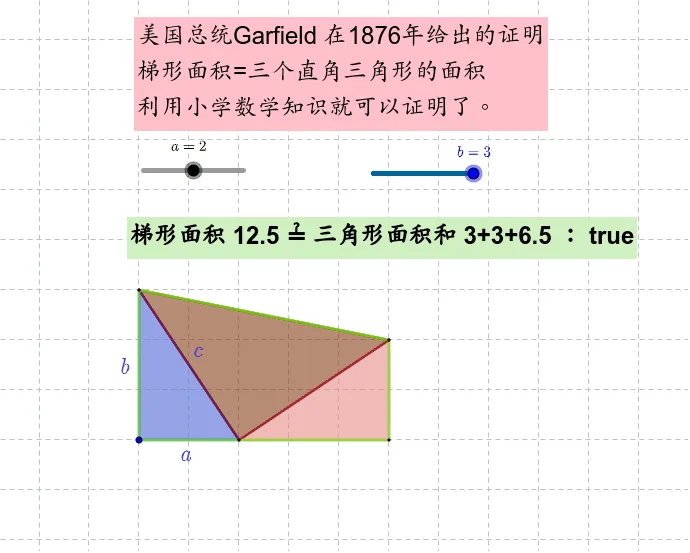
This GeoGebra example demonstrates a geometric (area-based) proof by decomposing the configuration around a right triangle into trapezoid regions and then matching/pasting their areas. It highlights the Pythagorean Theorem through a visual “dissection” argument: the relationship between the squares on the legs and the square on the hypotenuse. Key concepts include right-triangle geometry, decomposition/dissection proof ideas, and area conservation enabled by congruent/similar region correspondence. In the construction, the core drawing is produced with the GeoGebra command Polygon to create the main polygonal boundaries, while named points and objects (e.g., A, B, C, D, E plus many parameter-labeled vertices such as a_3, b_4, t1–t3, a_2, b_2, c_1, d_1, e_1, e_2, c_2) are used to position and control the trapezoid pieces. Additional labeled objects (text1, text2) support the proof narration, and the trapezoid-related object ptrape helps organize the key decomposed region. Suitable for middle/high school geometry lessons, interactive proof demonstrations, and students exploring alternative proofs of the Pythagorean Theorem.
Loading the math board and drawing, please wait…