
Axial Symmetry and Geometric Folding Exploration
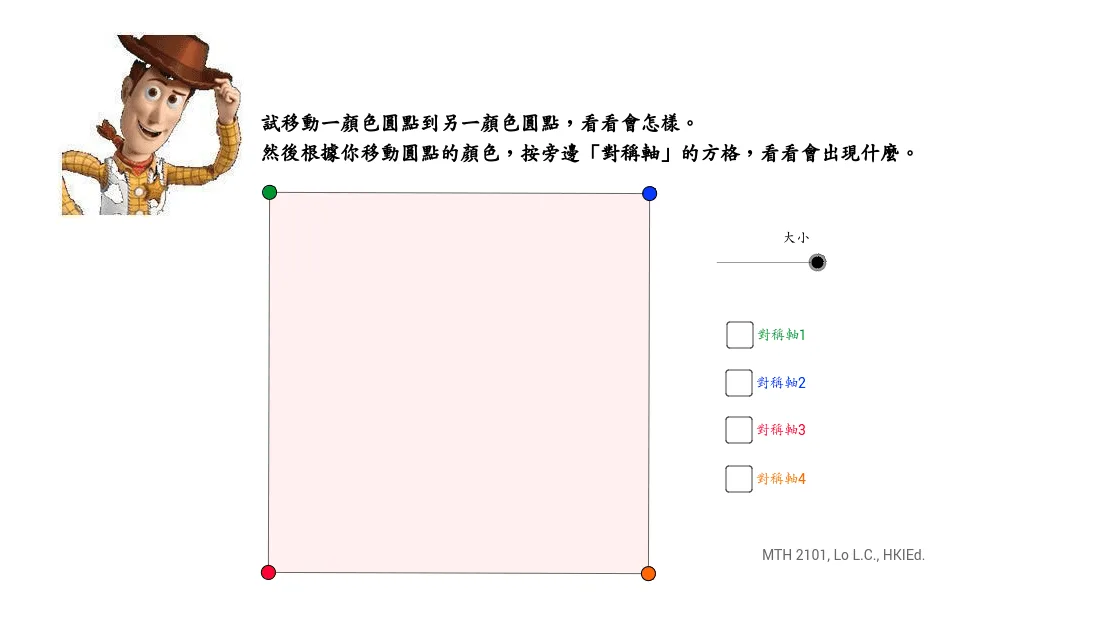
This GeoGebra applet demonstrates axial symmetry and geometric folding properties in plane geometry. Through interactive construction of polygons, circles, perpendicular lines, and midpoints, it explores how vertices play distinct roles during lateral folds versus diagonal folds. The applet guides users to observe how folding a geometric figure across an axis of symmetry produces congruent reflected images, and how specific choices of fold lines change the resulting configuration.
The investigation integrates several key mathematical concepts. Similar triangles arise naturally when examining the relationships between original and folded positions of vertices. Circumcircles are constructed to reveal deeper properties of the symmetric figures, such as points lying on common circles after folding. Angle measurements and angle relationships help verify symmetry conditions and identify which configurations preserve or alter angular properties under reflection.
Students interact with the applet by manipulating geometric objects in real time. They can move vertices, adjust fold lines, and observe how the reflected image responds dynamically. This hands-on exploration allows them to discover patterns independently rather than merely receiving definitions. For example, learners can test whether certain fold lines produce optimal symmetry, compare lateral and diagonal folding outcomes, and formulate conjectures about when folded figures form special shapes such as isosceles triangles or cyclic quadrilaterals.
The applet also encourages students to think critically about optimizing symmetric folding models. By adjusting parameters and comparing results, they can investigate which folds minimize distortion, maximize congruence, or produce desired geometric properties. This promotes a deeper understanding of why certain constructions work and how symmetry principles underpin broader topics in Euclidean geometry.
Overall, the applet serves as an effective exploratory tool for secondary mathematics students studying geometric transformations. It connects abstract symmetry concepts to concrete visual and interactive experiences, strengthening both intuition and formal reasoning. Teachers can use it as a classroom demonstration, a guided discovery activity, or an assignment that asks students to document their findings and justify their conclusions using the relevant theorems of geometry.
Loading the math board and drawing, please wait…