
Symmetry Exercises for Kids — Primary 4: Symmetry
This GeoGebra applet, titled Symmetry Exercises for Kids, is an interactive educational tool designed to introduce elementary and middle school students to the fundamental concepts of axial symmetry and reflection transformations. Utilizing the powerful Mirror command, the applet provides a dynamic and visually engaging environment where children can explore how geometric figures behave when reflected across a line of symmetry.
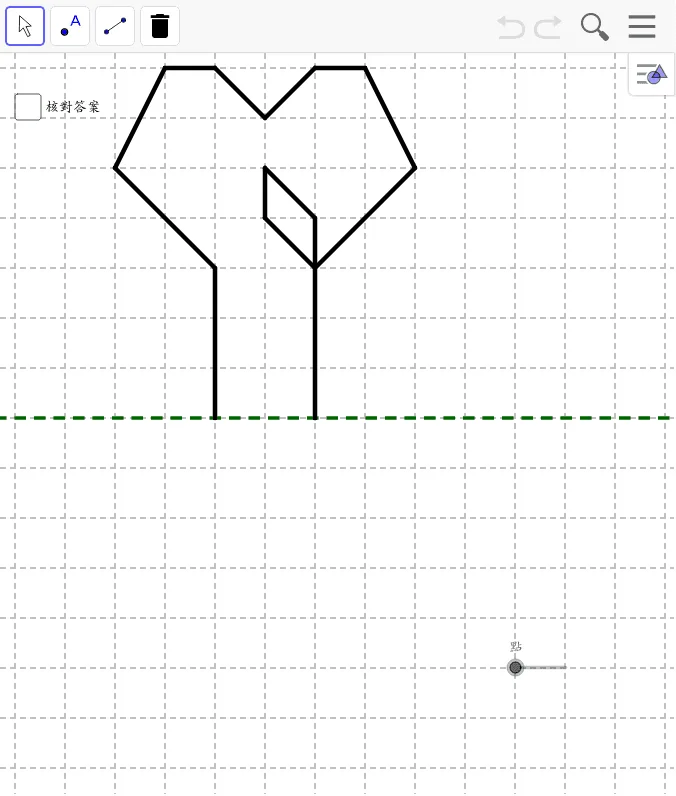
The workspace features a variety of foundational geometric shapes, including triangles, parallelograms, and other polygons, alongside a clearly defined axis of symmetry. As students interact with the applet, they can observe the original figures and their corresponding mirrored images in real time. A key feature of this exercise is the explicit labeling of vertices, allowing learners to track the precise correspondence between original points, such as A₁, B₁, and C₁, and their reflected image points, denoted as A', B', and C'.
Through hands-on exploration, students can drag the original vertices or manipulate the axis of symmetry to see how the reflected shapes instantly update. This interactive manipulation helps demystify the abstract properties of reflection. Specifically, it allows students to visually verify the core principles of axial symmetry: that the line segment connecting any original point to its image is perpendicular to the axis of symmetry, and that both the original point and its image are equidistant from the axis. By measuring these distances or simply observing the spatial relationships, children can concretely grasp the mathematical rules governing reflective transformations.
The applet is highly beneficial for young learners transitioning from concrete visual thinking to abstract geometric reasoning. It transforms a traditionally static textbook topic into an engaging, discovery-based learning experience. Teachers can use this tool to guide classroom discussions, prompt students to make conjectures about symmetry, and verify their hypotheses dynamically. Ultimately, this symmetry exercise builds a strong foundational understanding of spatial relationships, coordinate geometry, and transformational math, making it an invaluable resource for early geometry education.
Loading the math board and drawing, please wait…