
Pythagorean Theorem (Right Triangle_2)
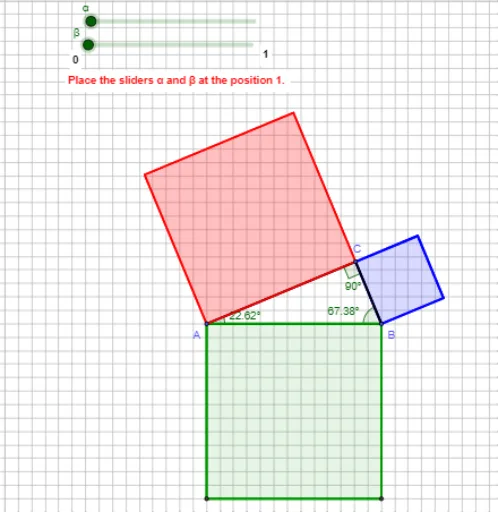
Loading the math board and drawing, please wait…
In collections
Pythagorean Theorem
This example demonstrates the Pythagorean Theorem using a right triangle. It constructs the relationship between the sides of a right triangle to illustrate the core concept of the theorem. Commands used include Circle, Intersect, Segment, Rotate, Angle, Ray, Polygon, Textfield, SelectedElement, SelectedIndex, Point, If. Suitable for middle school and above students to learn geometric construction and the Pythagorean Theorem.
GeoGebra Commands & Parameters
Circle(B, 5) → cCircle(A, 12) → c_1Intersect(c, c_1) → D, E, ,Segment(A, B) → fSegment(A, C) → gRotate(A, (-β), B) → Α'Angle(Α', B, A) → β_1Segment(A, B) → qSegment(B, C) → rAngle(C, B, A) → γRay(B, Α') → sIntersect(c, s) → G,Polygon(G, B, 4) → πολύγ3, t, a_1, b, d, G_1, HSegment(B, C) → eAngle(B, A, C) → δAngle(A, C, B) → εTextfield(empty1) → ΕισΑΒ2Textfield(empty2) → ΕισAC2Textfield(empty3) → ΕισBC2Textfield(empty4) → ΕισBCTextfield(empty5) → ΕισAC2kaiBC2Polygon(B, A, 4) → πολύγ1, h, j, k, h_1, Α, ΒSelectedElement(L) → text5SelectedIndex(L) → vSelectedIndex(L1) → wPoint(c_1) → IRotate(B, ζ, A) → B'Angle(B, A, B') → ηSegment(A, B') → mIntersect(c_1, m) → J,Polygon(A, J, 4) → poly1, n, p, b_1, d_1, K, MTextfield(empty7) → ΕισαΑCTextfield(empty6) → ΕισΑΒIf(ans5 ≟ 100, true, false) → AC2kaiBC2If(ans6 ≟ 13, true, false) → AB1If(ans1 ≟ 169, true, false) → AB2If(ans7 ≟ 12, true, false) → AC1If(ans2 ≟ 144, true, false) → AC2If(ans4 ≟ 5, true, false) → BC1If(ans3 ≟ 25, true, false) → BC2
AI Drawing Prompt Reference
Draw a right triangle ABC with A as the right angle. First, draw circles centered at A with radii 5 and 12, and their intersection points are B and C. Then draw line segments AB, AC, and BC, and angles BAC, ABC, and ACB. Next, use rotation and angles to construct auxiliary lines and segments, and finally label the lengths of each side and verify the Pythagorean theorem.
The prompt above was compiled from the original drawing commands and is for reference only.