
Pythagorean Theorem Proof Without Words by Ben Sparks
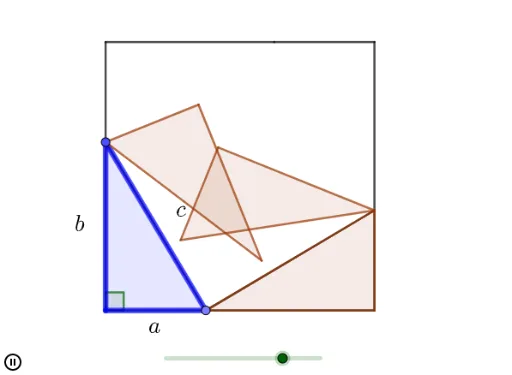
Loading the math board and drawing, please wait…
This example dynamically demonstrates the Pythagorean Theorem, showing that in a right triangle, the square of the hypotenuse equals the sum of the squares of the other two sides. It involves core concepts like the Pythagorean Theorem, geometric transformations, and coordinate geometry. Construction uses GeoGebra commands such as points, segments, rotations, orthogonal lines, and polygons. Suitable for high school mathematics teaching or exploration by math enthusiasts.
GeoGebra Commands & Parameters
Point(xAxis) → G_1Point(yAxis) → H_1Intersect(xAxis, yAxis) → ARay(A, H_1) → sRay(A, G_1) → rPoint(r) → BPoint(s) → CSegment(B, C) → fRotate(B, 90°, C) → B'Rotate(C, 90°, C) → C'Segment(B', C') → f'Rotate(B', 90°, B') → ERotate(C', 90°, B') → C''Segment(E, C'') → f''Rotate(E, 90°, C'') → B'''Rotate(C'', 90°, C'') → GSegment(B''', G) → f'''Segment(A, C) → gSegment(A, B) → hOrthogonalLine(B', yAxis) → iOrthogonalLine(C'', xAxis) → jIntersect(i, j) → FIntersect(i, yAxis) → DIntersect(j, xAxis) → HSegment(C, D) → kSegment(D, B') → lSegment(B', F) → mSegment(F, C'') → nSegment(C'', H) → pSegment(H, B) → qPolygon(A, B, C) → t1, a, a_1, bPolygon(C, E, D) → t2, d, c_1, eRotate(C, (-α), C) → C'_1Rotate(E, (-α), C) → E'Rotate(D, (-α), C) → D'Polygon(C'_1, E', D') → t2', d', c'_1, e'Polygon(E, F, G) → t3, g_1, e_1, f_1Polygon(G, H, B) → t4, b_1, g_2, h_1Rotate(E, α, G) → E'_1Rotate(F, α, G) → F'Rotate(G, α, G) → G'Polygon(E'_1, F', G') → t3', g', e'_1, f'_1OrthogonalLine(N, l) → t_1Segment(N, I) → cAngle(B, A, C) → βMidpoint(e') → JMidpoint(e'_1) → KMidpoint(g) → LMidpoint(f) → MMidpoint(h) → O