
Pulgarcito's Strategy
Loading the math board and drawing, please wait…
In collections
Realidades de GeoGebra
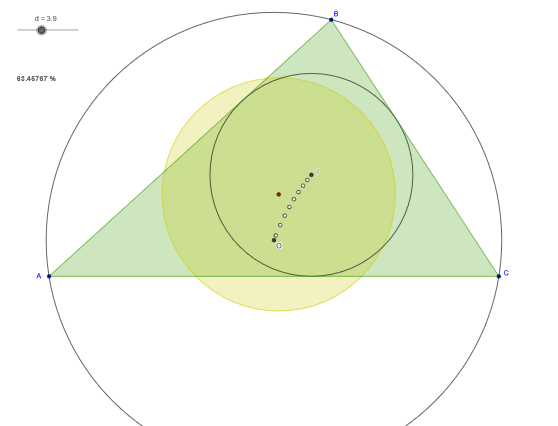
This example demonstrates how to solve an optimization problem using geometric construction tools. Key mathematical concepts include triangles, medians, angle bisectors, and hyperbolas. Using GeoGebra commands like Midpoint, Line, and AngularBisector, the geometric model of the optimization problem is constructed. Suitable for high school mathematics education and learning.
GeoGebra Commands & Parameters
Midpoint(C, B) → M1Line(A, M1) → mediana1AngularBisector(C, A, B) → bisectrizV1Mirror(mediana1, bisectrizV1) → simediana1OrthogonalLine(A, bisectrizV1) → jAngularBisector(A, C, B) → bisectrizV2Intersect(bisectrizV1, bisectrizV2) → IOrthogonalLine(C, bisectrizV2) → iIntersect(i, j) → I3Intersect(bisectrizV1, i) → I1Polygon(A, C, B) → isleta, v3, v1, v2LineBisector(v2) → mediatriz1LineBisector(v1) → mediatriz2Intersect(mediatriz2, mediatriz1) → OMidpoint(A, B) → M2Line(C, M2) → mediana2Mirror(mediana2, bisectrizV2) → simediana2Intersect(simediana1, simediana2) → LemoineConic(Lemoine, I, I3, I1, O) → h1Focus(h1) → Foco2, Foco1FirstAxisLength(h1) → semiejeHyperbola(Foco1, Foco2, semieje) → hSegment(O, B) → ROrthogonalLine(I, v1) → ortoIIntersect(v1, ortoI) → IbaseSegment(I, Ibase) → rAxes(h1) → eje2, eje1Slope(eje2) → mCenter(h1) → X110OrthogonalLine(G, v3) → g3Intersect(v3, g3) → G3Vector(G, G3) → u3Ray(P, R312) → s312Intersect(v3, s312) → S312Circle(P, d) → circuloPIntersect(circuloP, v3, 1) → P31Intersect(circuloP, v3, 2) → P32Midpoint(P31, P32) → PM3Ray(P, PM3) → sM3Intersect(circuloP, sM3) → PCM3,CircumcircleSector(P31, PCM3, P32) → sector2cEPolygon(P, P31, P32) → tri2c, z2c2, z2c3, z2c1Area(A, C, B) → areaiIntersect(circuloP, v1, 1) → P11If(P11 ≟ P11, true, false) → p11Intersect(circuloP, v1, 2) → P12If(P12 ≟ P12, true, false) → p12Midpoint(P11, P12) → PM1Ray(P, PM1) → sM1Intersect(circuloP, sM1) → PCM1,CircumcircleSector(P11, PCM1, P12) → sector2aEPolygon(P, P11, P12) → tri2a, z2a2, z2a3, z2a1OrthogonalLine(G, v1) → g1Intersect(v1, g1) → G1Vector(G, G1) → u1Ray(P, R112) → s112Intersect(circuloP, s112) → P112, Cir1CircumcircleSector(P11, P112, P12) → sector2aIntersect(v1, s112) → S112If(S112 ≟ S112, sector2a - tri2a, sector2a + tri2a) → area2aIntersect(circuloP, v2, 1) → P22If(P22 ≟ P22, true, false) → p22Intersect(circuloP, v2, 2) → P21If(P21 ≟ P21, true, false) → p21Midpoint(P21, P22) → PM2Ray(P, PM2) → sM2Intersect(circuloP, sM2) → PCM2, Cir2CircumcircleSector(P21, PCM2, P22) → sector2bEPolygon(P, P21, P22) → tri2b, z2b2, z2b3, z2b1OrthogonalLine(G, v2) → g2Intersect(v2, g2) → G2Vector(G, G2) → u2Ray(P, R212) → s212Intersect(circuloP, s212) → P212, Cir3CircumcircleSector(P21, P212, P22) → sector2bIntersect(v2, s212) → S212If(S212 ≟ S212, sector2b - tri2b, sector2b + tri2b) → area2bIf(P32 ≟ P32, true, false) → p32If(P31 ≟ P31, true, false) → p31If(p11 ∧ p12 ∧ p21 ∧ p22 ∧ p31 ∧ p32, true, false) → pos2EIntersect(circuloP, s312) → P312, Cir4CircumcircleSector(P31, P312, P32) → sector2cIf(S312 ≟ S312, sector2c - tri2c, sector2c + tri2c) → area2cIf(pos2E, aread - area2aE - area2bE - area2cE, area2) → area2ESegment(P, A) → dV1Segment(P, C) → dV2Midpoint(A, C) → M3Ray(P, M3) → fuera3Segment(P, B) → dV3If(dV1 ≤ d ∧ dV2 ≤ d ∧ dV3 ≤ d, true, false) → pos5If(pos5, areai, 0) → area5If(area5 < areai, area5, areai) → area5TIntersect(v2, fuera3) → Corte32Intersect(v1, fuera3) → Corte31If(p12 ∧ (¬p11), P12, P11) → P1If(P1 ≟ P1, true, false) → p1If(Distance[P21, P1] > Distance[P22, P1], P22, P21) → P21'Polygon(P, P1, P21') → tri621, ztri621c, ztri621b, ztri621aIf(Distance[P21, P1] > Distance[P22, P1], P21, P22) → P22'If(p22 ∧ (¬p21), P22, P21) → P2Midpoint(P2, P1) → V3bRay(P, V3b) → sV3Intersect(circuloP, sV3, 1) → V3cCircumcircleSector(P2, V3c, P1) → sector1cPolygon(B, P1, P2) → tri1c, z1c2, z1c3, z1c1Polygon(P, P1, P2) → tri01c, z01c2, z01c3, z01c1If(Distance[V3b, B] < dV3 ∧ Distance[A, P] < d, aread - sector1c + tri1c + tri01c, tri1c + sector1c - tri01c) → area1cPolygon(C, A, P2, P1) → cuadri3, zcuadri3a, zcuadri3b, zcuadri3c, zcuadri3dIf(Distance[P11, P2] > Distance[P12, P2], P12, P11) → P11'Polygon(P, P2, P11') → tri611, ztri611b, ztri611a, ztri611cIf(Distance[P11, P2] > Distance[P12, P2], P11, P12) → P12'If(P2 ≟ P2, true, false) → p2If(Distance[P31, P2] > Distance[P32, P2], P32, P31) → P31'Polygon(P, P2, P31') → tri632, ztri632a, ztri632c, ztri632bIf(Distance[P31, P2] > Distance[P32, P2], P31, P32) → P32'Polygon(B, P1, P32', P31', P2) → penta3, zpenta3e, zpenta3d, zpenta3c, zpenta3b, zpenta3aPolygon(P, P1, P32') → tri631, ztri631b, ztri631c, ztri631aIf(p31 ∧ p32 ∧ p1 ∧ p2 ∧ ((¬p11) ∨ (¬p12)) ∧ ((¬p21) ∨ (¬p22)), true, false) → pos6cIf(p11 ∧ p12 ∧ p21 ∧ p22 ∨ p11 ∧ p12 ∧ p31 ∧ p32 ∨ p21 ∧ p22 ∧ p31 ∧ p32, true, false) → pos2If(p32 ∧ (¬p31), P32, P31) → P3Polygon(C, P1, P21', P22', P3) → penta2, zpenta2c, zpenta2b, zpenta2a, zpenta2e, zpenta2dPolygon(P, P3, P22') → tri622, ztri622c, ztri622a, ztri622bMidpoint(P1, P3) → V2bRay(P, V2b) → sV2Intersect(circuloP, sV2, 1) → V2cCircumcircleSector(P1, V2c, P3) → sector1bPolygon(C, P1, P3) → tri1b, z1b2, z1b3, z1b1Polygon(P, P1, P3) → tri01b, z01b2, z01b3, z01b1If(Distance[V2b, C] < dV2 ∧ Distance[A, P] < d, aread - sector1b + tri1b + tri01b, tri1b + sector1b - tri01b) → area1bPolygon(A, B, P1, P3) → cuadri2, zcuadri2a, zcuadri2b, zcuadri2c, zcuadri2dPolygon(A, P2, P11', P12', P3) → penta1, zpenta1a, zpenta1b, zpenta1c, zpenta1d, zpenta1ePolygon(P, P3, P12') → tri612, ztri612c, ztri612b, ztri612aMidpoint(P2, P3) → V1bRay(P, V1b) → sV1Intersect(circuloP, sV1, 1) → V1cCircumcircleSector(P2, V1c, P3) → sector1aPolygon(P, P2, P3) → tri01a, z01a2, z01a3, z01a1Polygon(A, P2, P3) → tri1a, z1a2, tri1a3, z1a1If(Distance[V1b, A] < dV1 ∧ Distance[B, P] < d, aread - sector1a + tri1a + tri01a, tri1a + sector1a - tri01a) → area1aIf(area1a ≟ area1a, area1a, If[area1b ≟ area1b, area1b, area1c]) → area1If(area1 < areai, area1, areai) → area1TPolygon(C, B, P2, P3) → cuadri1, zcuadri1a, zcuadri1b, zcuadri1c, zcuadri1dIf(area4 < areai, area4, areai) → area4TIf(P3 ≟ P3, true, false) → p3If(p21 ∧ p22 ∧ p1 ∧ p3 ∧ ((¬p11) ∨ (¬p12)) ∧ ((¬p31) ∨ (¬p32)), true, false) → pos6bIf((¬p3) ∧ p1 ∧ ((¬p11) ∨ (¬p12)) ∧ p2 ∧ ((¬p21) ∨ (¬p22)), true, false) → pos1cIf((¬p2) ∧ p1 ∧ ((¬p11) ∨ (¬p12)) ∧ p3 ∧ ((¬p31) ∨ (¬p32)), true, false) → pos1bIf((¬p1) ∧ p2 ∧ ((¬p21) ∨ (¬p22)) ∧ p3 ∧ ((¬p31) ∨ (¬p32)), true, false) → pos1aIf(pos1a ∨ pos1b ∨ pos1c, true, false) → pos1If(pos1 ∧ dV2 ≤ d ∧ dV3 ≤ d, true, false) → pos4cIf(pos1 ∧ dV1 ≤ d ∧ dV3 ≤ d, true, false) → pos4bIf(pos1 ∧ dV1 ≤ d ∧ dV2 ≤ d, true, false) → pos4aIf(pos4a ∨ pos4b ∨ pos4c, true, false) → pos4If(p1 ∧ (¬p2) ∧ (¬p3) ∨ (¬p1) ∧ p2 ∧ (¬p3) ∨ (¬p1) ∧ (¬p2) ∧ p3, true, false) → pos3If(p11 ∧ p12 ∧ p2 ∧ p3 ∧ ((¬p21) ∨ (¬p22)) ∧ ((¬p31) ∨ (¬p32)), true, false) → pos6aIf(pos6a ∨ pos6b ∨ pos6c, true, false) → pos6CircumcircleSector(P2, P312, P1) → sector6cIf(pos6c, penta3 + sector6c - sector2c - tri631 - tri632, 0) → area6cCircumcircleSector(P1, P212, P3) → sector6bIf(pos6b, penta2 + sector6b - sector2b - tri621 - tri622, 0) → area6bCircumcircleSector(P2, P112, P3) → sector6aIf(pos6a, penta1 + sector6a - sector2a - tri611 - tri612, 0) → area6aIf(area2E < areai, area2E, areai) → area2TIf(area6 < areai, area6, areai) → area6TRay(P, M2) → fuera2Intersect(v1, fuera2) → Corte21Intersect(v3, fuera2) → Corte23Ray(P, M1) → fuera1Intersect(v3, fuera1) → Corte13Intersect(v2, fuera1) → Corte12Line(B, Lemoine) → simediana3Angle(B, A, C) → αAngle(A, C, B) → βAngle(C, B, A) → γIf(δ ≟ α, M1, If[δ ≟ β, M2, M3]) → MLine(M, Lemoine) → eIf(sector2c > aread / 2, sector2c + tri2c, sector2c) → sector2CIf(areaT > 0 ∨ Corte12 ≟ Corte12 ∨ Corte13 ≟ Corte13 ∨ Corte21 ≟ Corte21 ∨ Corte23 ≟ Corte23 ∨ Corte31 ≟ Corte31 ∨ Corte32 ≟ Corte32, areaT, aread) → areaAngle(isleta) → ε, ζ, ηLine(B, M3) → mediana3Intersect(bisectrizV2, j) → I2Circle(O, R) → circunscritaLine(G, O) → eulerMirror(euler, v2) → euler2Mirror(euler, v1) → euler1Intersect(h1, e, 2) → HIntersect(h1, euler, 1) → JSegment(J, I) → aIntersect(euler, euler1) → EESegment(O, B) → bCircle(I, Ibase) → fLine(O, I) → cCircle(O, P59, I) → g
AI Drawing Prompt Reference
Draw a geometric figure consisting of a triangle, an ellipse, and a circle. The triangle should have its centroid, angle bisectors, and perpendicular lines marked. The triangle and ellipse should be connected by intersection points. The ellipse's foci and axes should be labeled. The circle should intersect the ellipse to form a sector. The overall figure illustrates the optimization relationship between the triangle and the ellipse, suitable for mathematical education.
The prompt above was compiled from the original drawing commands and is for reference only.