
Dynamic Construction Related to Fermat's Problem Maximum Task
Loading the math board and drawing, please wait…
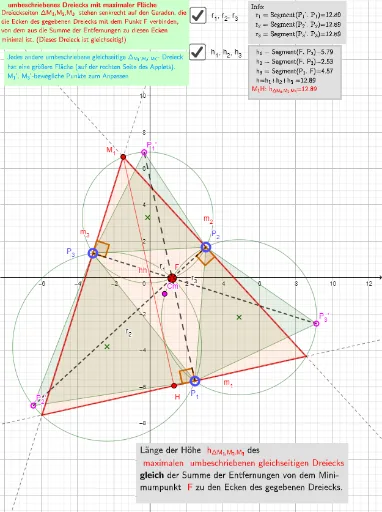
This example demonstrates a dynamic construction related to Fermat's problem of maximum, showcasing geometric transformations and optimizations through interactive geometry. Key math concepts include area, calculus, centroid, circumcircle, geometric constructions, isosceles triangles, special points, triangles, polynomial functions, translation, functions, multiplication, and logarithmic functions. The construction leverages GeoGebra commands such as Zip, Sequence, UnicodeToLetter, Polygon, Sum, If, Ray, Rotate, Point, Intersect, and Segment, with objects like P_{3}, P_{2}, P_{1}, lAngle, lP', P_{1}', lP, lr, lP_p, lM, M_{3}, bue, M_{2}, M_{1}, button1, u34, t1, lLog, br, lPoly, lCircle, Oi, F, P_{2}', P_{3}', Cm, M1, M2, M3, polyMax, m_{3}, m_{1}, m_{2}, lh, h_1, h_2, h_3, lAngle3, r_1, r_2. Suitable for high school and above students to explore geometric optimization and dynamic geometry software applications.
GeoGebra Commands & Parameters
Zip(Rotate[a1, If[b < 180°, (-(60°)), 60°], a2], a1, {P_{2}, P_{1}, P_{1}}, a2, {P_{3}, P_{3}, P_{2}}, b, {lAngle(3), lAngle(1), lAngle(2)}) → lP'Sequence(Segment[Element[lP', i], Element[lP, i]], i, 1, 3) → lrZip(OrthogonalLine[P, r], P, lP, r, lr) → lP_pZip(Intersect[a, b], a, {lP_p(1), lP_p(1), lP_p(2)}, b, {lP_p(2), lP_p(3), lP_p(3)}) → lMUnicodeToLetter(34) → u34Polygon(lP) → t1Zip(120° ≤ t ≤ 240°, t, lAngle) → lLogSum(lLog) → brZip(Center[c], c, lCircle) → OiIf(lLog(2), P_{2}, lLog(3), P_{3}, lLog(1), P_{1}, Intersect[lr(2), lr(1)]) → FPolygon(M_{1}, M_{2}, M_{3}) → polyMax, m_{3}, m_{1}, m_{2}Zip(Segment[F, a], a, lP) → lhZip(Angle[a, b, c], a, lP', b, lP, c, If[bue, {M_{3}, M_{1}, M_{2}}, {M_{2}, M_{3}, M_{1}}]) → lAngle3Ray(M1', P_{2}) → e2Rotate(P_{2}, (-(60°)), M1') → M11'Ray(M1', M11') → e1Point(e2) → M3'Rotate(P_{2}, 60°, M3') → M22'Ray(M3', M22') → e3Intersect(e1, e3) → M2'Polygon(M1', M2', M3') → poly, m_3', m_1', m_2'Intersect(OrthogonalLine[M_{1}, lP_p(1)], lP_p(1)) → HSegment(M_{1}, H) → hh