
Similar Triangles in Cartesian Coordinate System
Loading the math board and drawing, please wait…
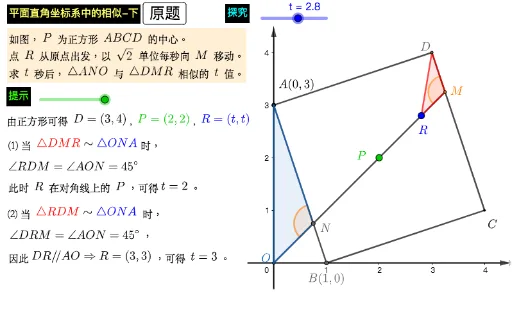
This example demonstrates how to construct similar triangles in a Cartesian coordinate system. It involves core mathematical concepts such as triangle similarity criteria, vector operations, linear programming or optimization, and matrix transformations. Key GeoGebra commands and objects used in the construction include Polygon, Vector, Textfield, Segment, Rotate, Intersect, and Angle, as outlined in the construction summary. It is suitable for high school and above students learning about coordinate geometry, similarity, and transformations.
GeoGebra Commands & Parameters
Polygon((wl, wd), (wr, wd), (wr, wu), (wl, wu)) → wn, wnd, wnr, wnu, wnlVector((wl, 0), (wr, 0)) → xaxisVector((0, wd), (0, wu)) → yaxisTextfield(k) → InputBox1Textfield(d) → InputBox2Segment(O, A) → sOARotate(A, ((-π)) / 2, B) → CSegment(A, B) → sABSegment(C, D) → sCDSegment(B, C) → sBCSegment(D, A) → sDAIntersect(sCD, Line[O, P]) → MSegment(O, M) → sOMIntersect(sAB, Line[O, M]) → NPolygon(D, R, M) → plDRM, m, d_1, rPolygon(A, O, N) → plAON, n, a_1, oAngle(A, N, O) → aANOAngle(D, M, R) → aDMR