
Pythagorean Theorem for Similar Shapes
Loading the math board and drawing, please wait…
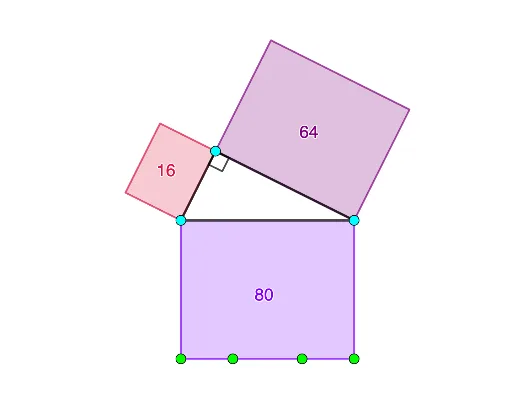
This example demonstrates the application of the Pythagorean Theorem in similar shapes, dynamically proving that corresponding side lengths of similar polygons satisfy the Pythagorean relationship. Key math concepts include the Pythagorean Theorem, similarity transformation, polygons, angles, and geometric transformations. Construction involves commands like Point, Semicircle, Segment, Polygon, Angle, and Dilate. Suitable for high school geometry and transformation learning.
GeoGebra Commands & Parameters
Point(xAxis) → APoint(xAxis) → BSemicircle(A, B) → cPoint(c) → CSegment(A, C) → fSegment(C, B) → gSegment(B, A) → hPolygon(A, D, E, F, G, B) → poly1, a, d, e, f_1, g_1, bAngle(B, A, C) → aaAngle(C, B, A) → bbDilate(Rotate[Polygon[Translate[A, A - B], Translate[D, A - B], Translate[E, A - B], Translate[F, A - B], Translate[G, A - B], Translate[B, A - B]], aa - 180°, A], f / b, A) → poly2Dilate(Rotate[Polygon[Translate[A, B - A], Translate[D, B - A], Translate[E, B - A], Translate[F, B - A], Translate[G, B - A], Translate[B, B - A]], 180° - bb, B], g / b, B) → poly3Angle(A, C, B) → α